
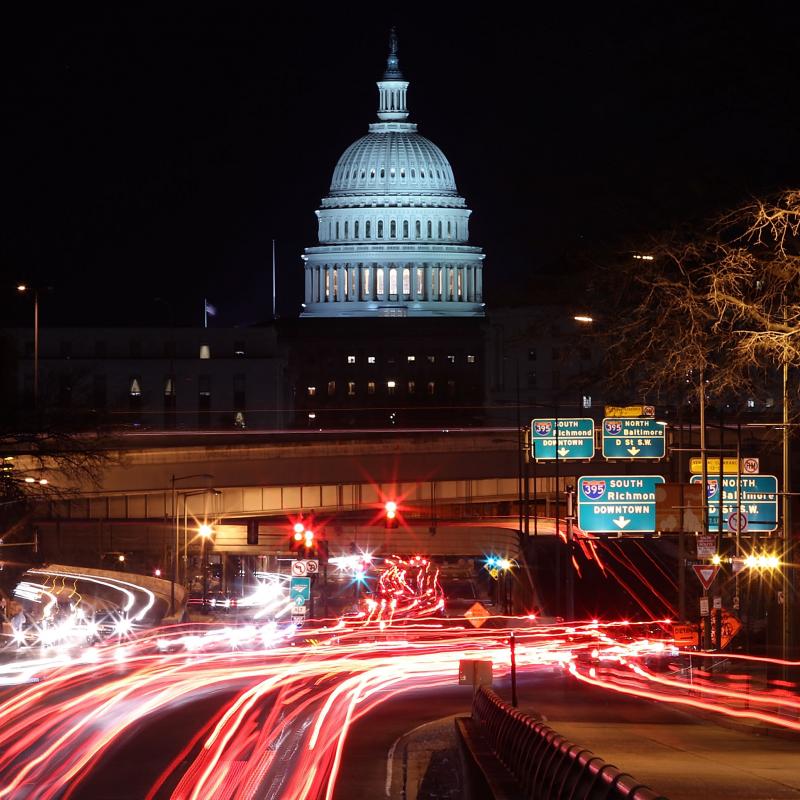
Nighttime view of the US Capitol building with a time-lapse of cars speeding by below

Government & Politics

Filter by

Select Topics

Select Air Date

to

Select Segment Types

Segment Types

4,520 Segments

Sort:

Newest

21:30

Lynn Amowitz

Dr. Lynn Amowitz is a senior researcher for Physicians for Human Rights, specializing in internal medicine, women's health and epidemiology. She's just returned from a trip to Iraq looking into the condition of health care. Over the years Amowitz has worked in Afghanistan, Kosovo, Sierra Leone, Zaire and Nigeria.

Interview
39:18

Author Robert Dallek, on John F. Kennedy

Robert Dallek has written a new biography of John F. Kennedy, An Unfinished Life. He looked into medical records to reveal new information about Kennedy's health problems, and he also discusses Kennedy's extramarital affairs and his life as a soldier. Dallek is a professor of history at Boston University. He previously wrote the biography Flawed Giant: Lyndon Johnson and His Times.

Interview
07:38

We remember journalist Elizabeth Neuffer of 'The Boston Globe'

We remember journalist Elizabeth Neuffer of The Boston Globe. She died last week in Iraq from injuries sustained in an automobile accident. She was reporting on the country's efforts to rid itself of the influence of Saddam Hussein's Baath Party. Neuffer was the Globe's Foreign Affairs/U.N. Correspondent. She reported on the fall of the Soviet Union, as well as ethnic strife in Bosnia, Kosovo and Rwanda. She has also reported on the war on terrorism from Afghanistan.

35:26

Sarah Chayes

Chayes is a former NPR reporter, is now field director of Afghans for Civil Society. It's a non-profit, non-governmental organization founded to promote a democratic alternative and to assist in the development of a civil society. ACS involves the community in reconstruction efforts, from physical reconstruction of a bombed-out village, to organizing a women's income generating project, to launching an independent radio station. The new independent documentary Life After War chronicles the group's efforts. While at NPR, Chayes reported from Paris, Kosovo and Afghanistan.

Interview
19:50

Actor John Malkovich

Actor John Malkovich is making his directorial debut with the new film The Dancer Upstairs. Malkovich has been nominated twice for an Academy Award for his work in the films In the Line of Fire and Places in the Heart. His other films include Heart of Darkness, Being John Malkovich, Shadow of the Vampire, Woody Allen's Shadows and Fog and Steven Spielberg's Empire of the Sun. Malkovich is also a founding member of Chicago's Steppenwolf Theatre Company.

Interview
30:32

Business Journalist Dan Briody

Author of The Iron Triangle: Inside the Secret World of the Carlyle Group (Wiley). The Carlyle Group is one of the most powerful and well-connected private equity firms in the world. Its investments — most notably — in timely defense and aerospace industries has made it highly profitable. The group's roster includes or has included former President George Bush, Sr., (advisor), former Secretary of Defense Frank Carlucci (former chairman), Saudi Arabian Prince Alwaleed Bin Talal (investor) and former Secretary of State, James Baker III (managing director and senior counselor).

Interview
13:47

Albert Mohler

Christian missionaries — mainline and evangelical — want to go to Iraq to provide humanitarian aid. But their presence would be troubling for many Muslims who are suspicious that aid is just a cover for another motive — converting Muslims to Christianity. We talk with two individuals with opposing views on the subject: Albert Mohler is a minister and president of The Southern Baptist Theological Seminary. He's considered a leader among American evangelicals. Southern Baptists are pledging to go into Iraq to provide humanitarian aid.

Interview
20:09

Former Episcopal Bishop of New York, Paul Moore

We remember former Episcopal Bishop of New York, Paul Moore. He died Thursday at the age of 83. Moore was known for his activism and concern for human rights. He was part of the civil rights movement and protested against the Vietnam War. As Bishop, he brought the church into dialogue with the poor and oppressed in New York. And he transformed the Cathedral of St. John the Divine into a thriving place for the community. In 1997 he published his memoir, Presences: A Bishop's Life in the City. This interview first aired December 15, 1997.

Obituary
20:57

Dr. Morton Rostrup

Rostrup is the international president of the medical relief organization Doctors Without Borders. He was the organization's medical coordinator in Baghdad. Rostrup just returned from five weeks in Baghdad. He was there before and during the war.

Interview
28:59

Journalist Philip Hilts

He's a longtime correspondent on health and science policy for The New York Times. In his new book, Protecting America's Health: the FDA, Business, and One Hundred Years of Regulation, he chronicles the history of the Food and Drug Administration from its start during the administration of Teddy Roosevelt. Hilts also broke the now-famous story of the Brown and Williamson tobacco industry papers, and is the author of Smoke Screen: The Truth Behind the Tobacco Industry Cover-Up.

Interview
45:10

Historian Margaret MacMillan

She is professor of history at the University of Toronto and the author of the new book, Paris 1919: Six Months That Changed the World, about the Peace Conference after World War I in which delegations from around the world convened to find an alternative to war. During the six months of the conference, new boundaries were drawn up in the Middle East. Out of that conference Iraq was born, and was for a time under British control. MacMillan's book, published under the title Peacemakers in England, was the winner of the Samuel Johnson Prize.

Interview
04:41

Amandla!

Critic Milo Miles reviews the new documentary and soundtrack Amandla! about protest music in black communities of South Africa during the Apartheid years.

Review
42:36

Author Jonathan Schell

In his new book, The Unconquerable World: Power, Nonviolence, and the Will of the People, he rethinks the relationship between war and political power. Schell writes that military power is not as effective as it once was, and that a more useful approach is one of cooperation with other nations. Schell is also the author of the 1982 classic The Fate of the Earth. He has written for The Nation, The New Yorker, Harper's Magazine and The Atlantic Monthly.

Interview
51:25

Journalist Charles Sennott

Charles Sennott is foreign correspondent for The Boston Globe. He was recently in northern Iraq where he traveled independently with a group of journalists. He was in Kirkuk when allied forces took the city from Baathist control. In Afghanistan, in 2001 Sennott traveled with the Northern Alliance. He is also the author of the new book The Body and The Blood: The Holy Land's Christians At the Turn of a New Millennium. (PublicAffairs). Sennott was the Globe's Middle East bureau chief.

Interview
31:55

Journalist Fareed Zakaria

He is the editor of Newsweek International and a political analyst for ABC News. His new book is The Future of Freedom: Illiberal Democracy at Home and Abroad. In the book, he argues that the spread of democracy does not always produce a corresponding growth of liberty. He gives examples of democratic elections that resulted in the election of dictators and autocrats. And he argues for a restoration of balance between democracy and liberty.

Interview
41:59

Professor David Fromkin

He is a professor of International Relations, International Law, and Middle Eastern Politics at Boston University. He's also the author of the best-selling book, A Peace to End All Peace: Creating the Modern Middle East 1914-1922. The book details how the geography and the politics of the Middle East were shaped by decisions by the Allies during and after World War I.

Interview
35:08

Postwar Iraq

She is co-director of the Post-Conflict Reconstruction Project at the Center for Strategic and International Studies. She will discuss many of the questions surrounding reconstruction in Iraq, such as the role of the United Nations and Iraqi exiles, the distribution of construction contracts, and the cost of reconstruction.

12:50

Professor Robert Jay Lifton

He is a professor of psychiatry and psychology at the Graduate School University Center and director of the Center on Violence and Human Survival at John Jay College of Criminal Justice at the City University of New York. He has written books on many topics, including the Japanese cult which released poison gas in the Tokyo subways, Nazi doctors, Hiroshima survivors and Vietnam vets. He'll discuss the emotional impact of the Iraq war on the American people.

Interview

All Subtopics

Did you know you can create a shareable playlist?

Advertisement

There are more than 22,000 Fresh Air segments.

Let us help you find exactly what you want to hear.
Just play me something
Your Queue

Would you like to make a playlist based on your queue?

Generate & Share View/Edit Your Queue