
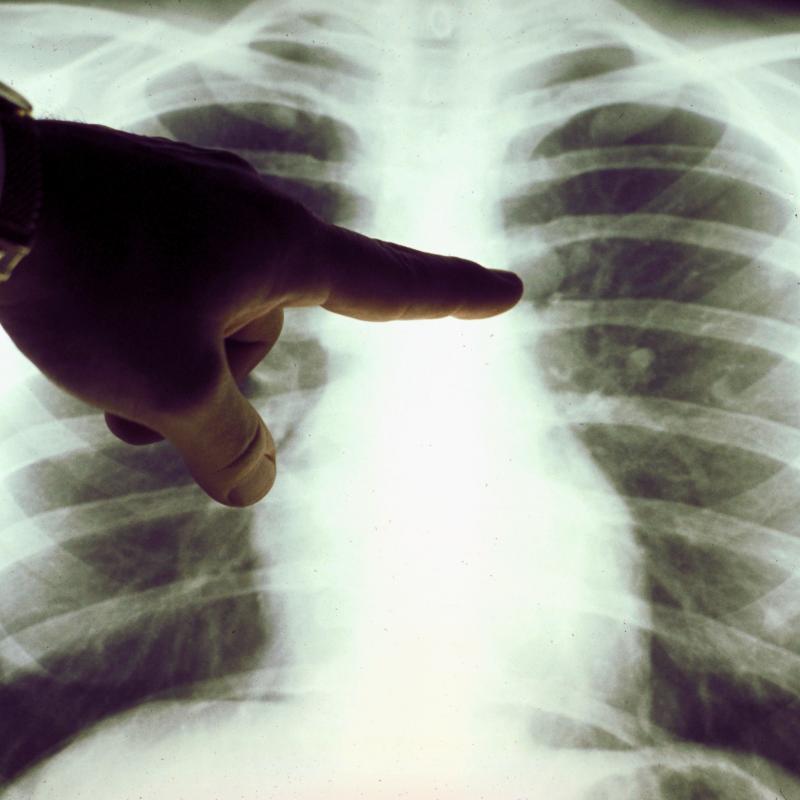
A doctor points a finger at a chest x-ray that shows the ribs

Health & Medicine

Filter by

Select Topics

Select Air Date

to

Select Segment Types

Segment Types

1,305 Segments

Sort:

Newest

15:58

Pharmacologist Dr. Avram Goldstein Discusses Addiction.

Pharmacologist Dr. Avram Goldstein. He set up some of the first methadone clinics to treat heroin addiction in California, and has a new book "Addiction: From Biology to Drug Policy" (Freeman). Goldstein argues that addictions are diseases, and must be considered a public health problem. A study released last month may back him up: 500,000 American deaths a year are attributed to cigarette, alcohol and drug use.

Interview
21:32

The Epidemic of Violence.

Violence prevention expert Deborah Prothrow-Stith. She's encouraged America to look at violence as a public health emergency. Stith says that instead of stitching up bullet wounds and returning people to the streets, we should teach violence prevention. Stith, assistant dean at Harvard School of Public Health, received the World Health Day Award in 1993. Stith co-wrote a book on violence called "Deadly Consequences" (Harper Collins) and a health textbook, "Health Skills for Wellness".

15:57

Writer Elaine Marcus Starkman.

Writer Elaine Marcus Starkman. Starkman's new book, "Learning to Sit in Silence: A Journal of Caretaking" (Papeir-Mache), is a fictionalized journal of caring for her elderly mother-in-law. Starkman explores the love, guilt, and anger that accompanies aging and death for so many. Starkman has also written "The Best Time" and "Love Scene." (Interview by Marty Moss-Coane)

22:41

On Why We Shouldn't Be Complacent about AIDS.

Doctor Marcus Conant. In the early 1980's Dr. Conant was among the first doctors in San Francisco to treat AIDS cases. Now Dr. Conant heads the largest private AIDS medical practice in San Francisco. After his 1985 study on how condoms block transmission of the AIDS virus, condoms became a household word. Dr. Conant is the director of AIDS Clinical Research Center and the co-director of the Kaposi's Sarcoma Clinic at the University of California at San Francisco.

Interview
13:51

Professor Marc Roberts Breaks Down the Clinton Health Care Plan.

Professor of Political Economy and Health Policy Marc Roberts. He's written a new book about the health care crisis: "Your Money or Your Life: The Health Care Crisis Explained." (Doubleday). Roberts will talk with Terry about Clinton's health care plan, which the president presented to Congress yesterday. Roberts is on the faculty at the Harvard School of Public Health and the John F. Kennedy School of Government.

Interview
22:58

Abortion Provider Dr. Susan Wicklund.

Dr. Susan Wicklund. She provides abortions services to women in Montana and South Dakota, traveling 4 hours each way. Without Wicklund's services, abortions would not be available to women in North Dakota. In the past she has worked in up to five clinics in three states while living in Montana with her teenage daughter. Wicklund has been featured on "60 Minutes." She will receive the Elizabeth Blackwell Award for her outstanding dedication to women's health care on October 29th.

Interview
17:45

Football Player, Writer, and Law Student Tim Green.

Defensive lineman for the Atlanta Falcons, Tim Green. Green's written a novel, "Ruffians" (Turner), about a football star who's NFL experience is dominated by money and steroids. During football season, Green writes a weekly column for the "Syracuse Herald-Journal". Off season, Green attends law school. His sports commentaries can be heard occasionally on NPR.

Interview
44:39

Dr. David Spiegel Discusses Care for the Terminally Ill.

Dr. David Spiegel, a professor of psychiatry and behavioral sciences at Stanford University School of Medicine. His groundbreaking study of breast cancer patients showed that women who had psychosocial intervention lived twice as long, after diagnosis, as those without that intervention. His new book, "Living Beyond Limits" (Times Books) covers current research on mind/body interactions, how to build sustaining support networks, control pain through self-hypnosis and detoxify fears of dying.

Interview
22:15

James Earl Jones Discusses his Life and Career.

Actor James Earl Jones. His is one of the distinctive voices of our time, yet few people know he fights a stutter; Jones' stage work off-Broadway in Jean Genet's "The Blacks" and Athol Fugard's "The Blood Knot" lead to a Broadway success in "The Great White Way", for which Jones won a Tony. His work in August Wilson's "Fences" won him another. It took one day to record the voice track for Darth Vader in "Star Wars": a performance which lead to many other commercial voice-over projects.

Interview
43:47

Bioethicist George Annas.

Bioethicist George Annas and Director of the Law, Medicine & Ethics Program, Boston University Schools of Medicine, Public Health and Law. "Standard of Care," (Oxford University Press) is his new book which examines how the law has shaped medical practice. ANNAS believes the law has a bigger impact on medical ethics than does philosophy or medicine. For instance, he says because doctors are afraid of litigation, they often don't use sound medical judgement.

Interview
22:59

It's Time to Talk Frankly About Death.

Medical ethicist Daniel Callahan. His new book is "The Troubled Dream of Life: Living with Mortality." (Simon & Schuster). In it he looks at how our society views death: If death is a "part of life," why do we have such trouble accepting it? And how do our attitudes about death affect medical and social policy?

Interview
13:19

Robert Hine on Losing and Regaining his Sight.

From sight to blindness to sight again. Robert Hine is Professor of History at the University of California. He lost his sight 15 years ago, and just recently regained the use of one eye. He's written a new book about what it's like to lose one's sight and then to see again: "Second Sight." (University of California Press).

Interview
22:43

The Plight of the Children of Women with AIDS.

Today's first half is about children who are orphaned after losing their parents to AIDS. Studies estimate that by the year 2000, up to 125,000 U.S. children will be left parentless because of the fatal illness. AIDS workers are now beginning to realize their next step is to help these secondary victims by providing homes, food and counseling. We interview two people on the subject; a single mother with AIDS, and the head of a project designed to address the needs of orphaned kids:

16:26

Health Care in War Zones.

Dr. Kevin Cahill. He specializes in tropical medicine, and he looks at the role of health in promoting world peace. He is President and Director of the Center for International Health and Cooperation in New york. His work looking at health amid natural disasters and wars has taken him all over the world, from Nicaragua in the 70s to Somalia today. He is the author or editor of 22 books.

Interview
16:14

Caring for AIDS Patients.

Betsy Lieberman, Executive Director of AIDS Housing of Washington which has built the country's first nursing home designed for people dying of AIDS. It's called the Bailey-Boushay House. The House also offers adult day-care services and activities for people with AIDS. The House has been in operation for a little over a year now. Since then more than 130 people have died there. A new book about the project has been published, "Breaking New Ground: Developing Innovative AIDS Care Residences." (published by AIDS Housing of Washington, Original Trade Paperback).

Interview
14:45

Women's Clinic Director Diane Strauss Discusses Operaration Rescue.

Regional Director of four women's clinics in Cherry Hill, New Jersey, Philadelphia, Pennsylvania, and Omaha, Nebraska, Diane Strauss. Three of her clinics were the target of Operation Rescue's protests last week. Before that, Strauss has been harassed at home by the group. In 1987, one of STRAUSS's clinics was the first clinic to be targeted by Operation Rescue outside of Binghamton, New York where the group is based.

Interview
22:55

Nancy Mairs Discusses her New Memoir.

Poet, writer, and teacher Nancy Mairs. She's a Catholic feminist, who started out Protestant, and who late in life became a feminist. She calls herself, "the connoisseur of catastrophe." She's known for writing honestly about her struggles with multiple sclerosis, depression, and the life-threatening illness of her husband, also about being a woman, a mother, and a wife. Her newest book of personal essays is "Ordinary Time," (Beacon). One reviewer calls it "a small miracle of honesty mediated by dignity and humor."

Interview
22:08

Musician and Record Producer Ron Levy.

Musician and record producer, Ron Levy. He was asked to played in B.B. King's band, when he was just out of high school. He went on to form "Ron Levy's Wild Kingdom, and recorded with the "luminaries" of the late seventies blue wave revival: Kim Wilson and Jimmie Vaughan and others. He started producing for Rounder Records and ended up working with old blues legends on Rounder's Blues label. Levy has long championed the Hammond B-3 organ which has come back into vogue. And he has a new Wild Kingdom release, "B-3, Blues and Grooves." (Rounder).

Interview

Did you know you can create a shareable playlist?

Advertisement

There are more than 22,000 Fresh Air segments.

Let us help you find exactly what you want to hear.
Just play me something
Your Queue

Would you like to make a playlist based on your queue?

Generate & Share View/Edit Your Queue