
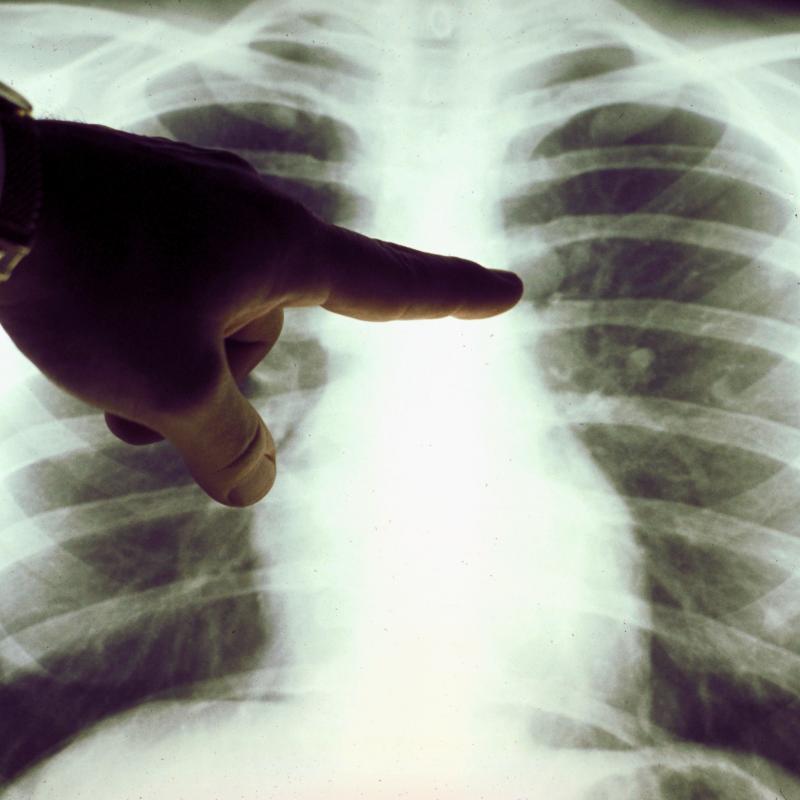
A doctor points a finger at a chest x-ray that shows the ribs

Health & Medicine

Filter by

Select Topics

Select Air Date

to

Select Segment Types

Segment Types

1,309 Segments

Sort:

Newest

45:42

Providing Medical Care to Homeless Populations

Dr. David Hilfiker is a physician who left a rural family practice in Minnesota to treat the urban poor. In his new book, "Not All of Us Are Saints," he describes his frustration both with the system that allows people to live in poverty, and with the patients who frequently flout his medical advice. Hilfiker's first book, "Healing the Wounds" won the "American Medical Writers Associatin" prize, and was named among the "Best Books of the Year" from the NYT Book Review.

Interview
44:44

How Poetry Preserves our Individuality in the Corporate World

David Whye is a poet who uses poetry to teach corporate executives and employees how to find satisfaction in the workplace. In his new book, "The Heart Aroused: Poetry and the Preservation of the Soul in Corporate America," Whyte looks at the ways people can use their careers not only as a means to earning a living, but as a way of finding personal happiness. He has served as a consultant for such companies as AT&T and Kodak, and runs a small press in Seattle, Washington.

Interview
43:46

The Current State of AIDS Research

Dr. Mark Feinberg is the director of the Virology Research Laboratory at San Francisco General Hospital and the Associate Director of the UCSF Center for AIDS Research. He just returned from the 10th International Conference on AIDS in Japan. For the past ten years, Feinberg has been studying how the HIV virus causes AIDS; recently he has focused on people who have had the HIV virus for many years, but have not yet shown AIDS symptoms.

Interview
15:20

Jane Hamilton Draws "A Map of the World"

Hamilton's new novel is about a Midwestern farm family whose lives are changed irrevocably by one terrible incident. Her first book, "The Book of Ruth," won the 1989 PEN/Hemingway Foundation Award for best first novel.

Interview
22:45

Providing Medical Care to the Wounded and Ill in Rwanda

Last week, a cholera epidemic broke out in Rwanda, and the country now has limited medical facilities and few physicians. Dr. John Sundin worked during May and June at the Red Cross hospital in Kigali, Rwanda. He'll talk about the cholera epidemic, and about his experiences working as the only surgeon in Kigali.

Interview
15:42

A Black Author on Losing His Father, Not Fitting Into American Life

Writer Alexs Pate's first novel is called "Losing Absalom." It's a fictionalized tribute to his father that chronicles end of the title character's life as his family has gathered around his hospital bed. Writer John Willimas wrote, "Losing Absalom is a powerful yet sensitive embrace with black America today." Pate grew up in North Philadelphia and lives in Minneapolis.

Interview
13:24

Remembering Red Rodney.

Jazz musicians Red Rodney and Sonny Sharrock. They're both important jazz figures who recently died. We will rebroadcast previous interviews with both Rodney was a trumpeter and band leader. He rose through the big band ranks and played in Charlie Parker's quintet. He was known as one of jazz's best improvisers. And he was known for regaling journalists with his stories-- often of dubious veracity. (Rebroadcast of 6/15/1990)

Obituary
43:09

Treating AIDS in Tennessee.

Author and physician Abraham Verghese. An Indian raised in Ethopia, Abraham Verghese arrived in the United States in 1980 as a rookie doctor. Upon completing an internship in infectious diseases, Dr. Verghese accepted a position in the rural, Appalachian town of Johnson City, Tennessee. The year was 1985 and AIDS had begun to ravage large metropolitan areas. Within the year, Dr. Verghese was treating his first case of AIDS in this rural outpost.

Interview
22:23

Reynolds Price On Life After Paralysis.

Writer and teacher Reynolds Price A native of North Carolina, Price has written works known for their sense of place and off-beat characters. He's a prolific and a varied writer: he 's written short stories, poems, plays, and essays, and since the publication of his first novel, "A Long and Happy Life," in 1962, he's published more than two dozen books. In 1984 Price was diagnosed with spinal cancer, and became paralyzed from the waist down. Cancer, though, didn't slow his writing down.

Interview
15:08

What Brain Surgery Reveals about How the Brain Works.

Neurophysiologist William Calvin. He assisted in neurosurgery on a patient named Neil. Neil was to have a portion of his temporal lobe removed to cure his severe epilepsy. But the neurosurgeon, George Ojemann, had to know where to cut. A mistake could cost Neil part of his normal brain function. So, while Neil was awake on the operating table, Dr. Ojemann, probed and stimulated Neil's exposed brain, the whole time carrying on a conversation with the patient. The purpose was to create a detailed roadmap of Neil's brain functioning.

Interview
22:24

Jazz Pianist Fred Hersch.

Jazz pianist Fred Hersch. His new solo album is "Fred Hersch at Maybeck." Hersch recently revealed he is HIV positive and appears on several recordings to fund raise for the disease.

Interview
22:44

The History of Surgery.

Dr. Ira Rutkow is a surgeon and the author of the new book, "Surgery: An Illustrated History," (Mosby). The book has 386 illustrations including documents, photographs, cartoons, drawings and paintings related to surgery, taken from museums throughout the world. Rutkow has also written a two-volume history of surgery in the U.S. and has written studies on Civil War surgery. He's also consulting editor for surgical history for the Archives of Surgery. Rutkow is founder and surgical director of The Hernia Center in Freehold, N.J.

Interview
22:33

The Myth of Death with Dignity.

Dr. Sherwin Nuland is a surgeon, and he teaches surgery and the history of medicine at Yale. In his new book, "How We Die: Reflections on Life's Final Chapter," (Knopf), he writes that few of us have an understanding of the way people die because 80 percent of Americans die in the hospital, and, for the most part their deaths are concealed. Nuland's new book is an attempt to "demythologize" the process of dying and he presents death in its biological and clinical reality.

Interview
23:17

War Surgeon Dr. Chris Giannou Discusses the Situation in Burundi.

War surgeon Dr. Chris Giannou, who recently worked through the devastating civil war in the East African country of Burundi. In the ensuing ethnic and political conflict between the Hutu and the Tutsi peoples there, at least two hundred thousand people were been killed, oftentimes not with guns, but with machete knives and spears. Giannou has spent over 12 years working in the world's hotspots: Somalia, Lebanon, Cambodia.

Did you know you can create a shareable playlist?

Advertisement

There are more than 22,000 Fresh Air segments.

Let us help you find exactly what you want to hear.
Just play me something
Your Queue

Would you like to make a playlist based on your queue?

Generate & Share View/Edit Your Queue