
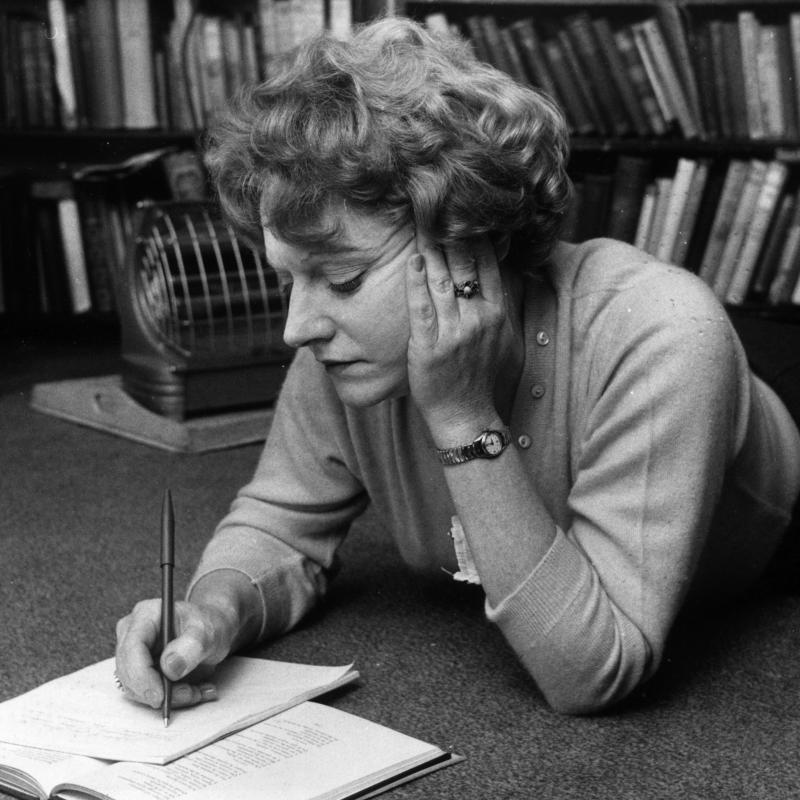
Author Muriel Spark writing

Books & Literature

Filter by

Select Topics

Select Air Date

to

Select Segment Types

Segment Types

5,401 Segments

Sort:

Newest

22:52

Scholarship and Blackness.

Henry Louis Gates, Jr. is an African-American historian. He attended Yale University in the late '60s. The New York Times describes Gates as "a 41-year-old academic entrepreneur who has been one of the most sought-after scholars in the country in the last decade." Gates has taught at Yale, Cornell and Duke. Now he's been recruited to revitalize Harvard's African-American studies department, serving as its new chairman. He's written for Newsweek, Time, and The Nation.

15:44

Pro-Golfer Charlie Sifford.

Pro Golfer Charlie Sifford. He was the first black admitted to the PGA in 1961. Even so, he's found that blacks are still not welcome in the game of golf. His new book is "Just Let Me Play," written by Sifford with James Gullo (by British American Publishing, 19 British American Boulevard, Latham, New York, 12110).

Interview
16:09

Roger D. Stone Discusses Environmental Policy.

Author and Senior Fellow at the World Wildlife Fund, Roger D. Stone. He's on his way to Rio de Janeiro for the Earth Summit. His book, "The Nature of Development: A Report from the Rural Tropics on the Quest for Sustainable Economic Growth," (by Knopf) in which he theorizes that the only way to protect an environment is to provide economically viable, ecologically sound alternatives for the the people who live there.

Interview
22:54

Novelist and Screenwriter Richard Price.

Novelist and screenwriter Richard Price. His screenwriting credits include "The Color of Money," "Sea of Love," and Martin Scorsese's section of "New York Stories." He's returned to novel writing with "Clockers," a murder mystery set in the world of a crack dealer in New Jersey. Christopher Lehmann-Haupt of The New York Times writes "the signal achievement of "Clockers' is to make us feel the enormous power of these giants that are drugs, alcoholism, poverty." (published by Houghton Mifflin).

Interview
22:15

Novelist Terry McMillan.

Writer Terry McMillan. Her new novel, "Waiting to Exhale," (Viking) is about four strong, urban black women in their thirties, their successful careers, and their sometimes volatile relationships with black men. She says women -- both black and white -- are frustrated because they can't find a man who's willing to commit, and won't lie and cheat. Her previous novels are "Mama" and "Disappearing Acts."

Interview
22:59

Glenda Lockwood Discusses her Time as an Iraqi Prisoner.

Glenda Lockwood. She and her family were living in Kuwait when the Iraqis invaded in August 1990. Later the family was taken to Bagdad as "human shields" and Glenda's son, Stuart Lockwood, was seen on international television being coaxed by Saddam Hussein. It was a propaganda effort on Hussein's part that failed, and ended up infuriating viewers around the world. Glenda Lockwood's new book is " Dairy of a Human Shield." (by Bloomsbury, distributed by Trafalgar Square, North Pomfret, Vermont 05053).

Interview
13:57

Writer Randall Kenan.

Novelist Randall Kenan. He was raised in the rural, North Carolina, a part of the country in which he says "it's hard to distinguish between the myths and reality." His new book, "Let the Dead Bury Their Dead," is a collection of stories, about a five-year old who can hear the dead speak, an Asian man who falls from the sky and encounters mindless violence and racism, and a conventional widow who copes with the revelation that her grandson is a homosexual, and others.

Interview
22:18

Writer Benjamin Cheever.

Benjamin Cheever is the son of the late John Cheever. Ben is also a writer, and he grew up in the shadow of his father's fame. He's just written his first novel, for which he says he finally found his own voice, separate from his father's. "The Plagiarist" (Atheneum) is loosely based on Ben's life, and the time he spent working at "Reader's Digest" magazine. Ben was also the editor of "The Letters of John Cheever," published in 1988.

Interview
22:50

Wendy Kaminer Dissects the Self-Help Culture.

Journalist and lawyer Wendy Kaminer (cam-AH-ner). Her new book, I'm Dysfunctional, You’re Dysfunctional, is a critical look at the recovery and self-help movement. Kaminer believes that the movement tends to trivialize suffering by refusing to distinguish among levels of suffering or victimization (for instance, one recovery expert suggests that childhood is a holocaust.) Kaminer also considers the political implications for democracy if people view themselves as victims. (by Addison-Wesley Publishing Company).

Interview
16:44

Gayle Pemberton Discusses her Memoir..

Writer and professor Gayle Pemberton. She is associate director of Afro-American Studies at Princeton University. Her new book, The Hottest Water in Chicago: on family, race, time, and American culture, is a collection of autobiographical essays. Pemberton was born into a northern black middle-class family in the late 1940s. (by Faber & Faber)

Interview
22:59

Journalist Bill Buford Discusses Soccer "Hooligans."

Journalist Bill Buford. He traveled for eight years with "soccer thugs" -- England's hardcore soccer fans known for their violent outbreaks surrounding England's soccer games. Buford witnessed "lads" urinating on fellow spectators, commuter trains being demolished, a pub being robbed, and saw stabbings. He wanted to understand the violence that has caused many deaths (including the death of 66 fans asphyxiated in a crush of people trying to get out of a stadium in Glasgow in 1971).

Interview
12:54

Nigerian Writer Ben Okri.

Nigerian writer Ben Okri. His novel, "The Famished Road," won Britian's prestigious Booker Prize in 1991. It's about a young boy growing up in a poor African village. He's written four other novels and a collection of short stories. Besides "The Famished Road," the only other book of his published in the U.S. is his book of short stories. (Interview by Marty Moss-Coane)

Interview
22:49

Military Bases and Toxic Waste.

Marty talks with science writer Seth Shulman about how the military has left toxic wastes in bases all across the country. His new book is "The Threat at Home: Confronting the Toxic Legacy of the U.S. Military." (Interview by Marty Moss-Coane)

Interview
22:25

Salman Rushdie Discusses Fighting the Fatwa Against Him.

Controversial author Salman Rushdie. Terry last talked to him in late 1990 about his life. For over three years, Rushdie's been in hiding, a result of the reaction to his novel "The Satanic Verses." That novel offended many Muslims and led to the Ayatollah Khomeini putting a one-million-dollar death sentence on Rushdie's head. Just lately, he's begun to travel and make public appearances, even though he's still a target for assassination. Rushdie called us from his hiding place somewhere in Great Britain.

Interview
16:16

Frances Lear Discusses her Memoir.

Frances Lear founded Lear's Magazine. At one time she was married to TV producer Norman Lear, and though her life, from the outside, seems quite pleasant and successful, her new memoir "The Second Seduction" details a life full of pain.

Interview

Did you know you can create a shareable playlist?

Advertisement

There are more than 22,000 Fresh Air segments.

Let us help you find exactly what you want to hear.
Just play me something
Your Queue

Would you like to make a playlist based on your queue?

Generate & Share View/Edit Your Queue