
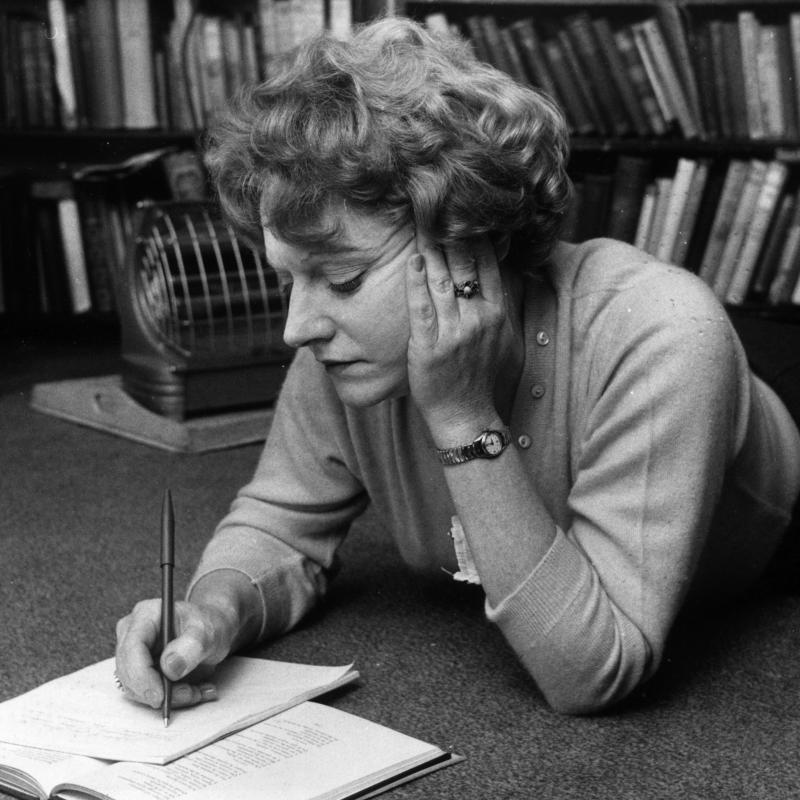
Author Muriel Spark writing

Books & Literature

Filter by

Select Topics

Select Air Date

to

Select Segment Types

Segment Types

5,350 Segments

Sort:

Newest

04:28

The City of the Future.

Critic Maureen Corrigan reviews "City of Quartz" by Mike Davis (Vintage), a non-fiction look at the city of Los Angeles.

Review
22:45

Novelist Toni Morrison.

Novelist Toni Morrison. She has a new novel "Jazz," (published by Knopf) and a new book of essays, "Playing in the Dark," (by Harvard). Her novel, "Beloved," won a Pulitzer prize. She's written six novels in all.

Interview
08:39

Writer David Marc Discusses the Past and Present of Television.

Writer David Marc. He's the co-author of the new book, "Prime Time Prime Movers," about how TV's producers are the ones who most influence its creative and ideological direction. They cite such examples as Stephen Bochco, the creator of "Hill Street Blues," and "L.A. Law," and "Cop Rock." (published by Little, Brown & Co.)

Interview
22:17

Writer Michael Tolkin.

Michael Tolkin, who wrote the novel and screenplay for the new Robert Altman movie, "The Player" (Fine Line Features, opening wide tomorrow), gives a screenwriter's take on the way Hollywood works -- or doesn't. Tolkin also wrote, directed and produced the film, "The Rapture," now available on home video.

Interview
15:49

Lloyd Schwartz Discusses his Poetry.

Our classical music critic Lloyd Schwartz has a new collection of poems, "Goodnight, Gracie," (published by Phoenix Poets). David Lehman calls this new collection, "a moving and inventive collection, his best and most ambitious to date." LLOYD is also music editor of The Boston Phoenix and is co-director of the Creative Writing Program at the University of Massachusetts.

Interview
22:46

Recognizing Earth Day with Donella Meadows.

Journalist and professor of environmental studies Donella Meadows. Twenty years ago she co-authored the book, "The Limits to Growth." The book used a computer model to project the impact of growth on the environment. It caused a sensation because of it's eco-gloom and helped spur the environmental movement. Now in the authors' sequel, "Beyond the Limits," they argue that we have shot past the earth's limited resources but that we are in a better position to avoid global economic collapse because of new technical possibilities.

Interview
16:26

Lewis Thomas Discusses Being a Doctor.

Pathologist, professor, and essayist Lewis Thomas. As an essayist he takes a philosophical look at biomedicine. His books include the "The Lives of a Cell," and "The Medusa and the Snail," which were both best sellers. But he began writing for only the medical community with his 1974 column in the "New England Journal of Medicine." Terry talks with him from his hospital room, where Thomas is recovering from several ailments. He has a new book, "The Fragile Species," (published by Scribner's)

Interview
22:23

Annie Dillard Discusses her First Novel.

Author Annie Dillard. She's written several non-fiction books; her new book, "The Living," (HarperCollins) is her first novel. Dillard's other works include the bestseller "The Writing Life," and the Pulitzer prize winning "Pilgrim at Tinker Creek." (Both are published by Harper &Row.)

Interview
14:49

The Pop Culture Residue of the Cold War.

Now that the Cold War's over, Pop culture scholar Michael Barson has written "Better Dead Than Red! A Nostalgic Look At The Golden Years Of Russiaphobia, Red-Baiting, And Other Commie Madness." (Hyperion) It's a look at how popular culture fueled public hysteria during the cold war -- from the Children's Crusade Against Communism bubble gum card series to the Hollywood production "I was a Communist for the F-B-I." By the way... the book is due to arrive in stores on Mayday 1992.

Interview
03:52

American Perspectives on Race.

Book critic John Leonard reviews Studs Terkel's new book, "Race: How Blacks and Whites Think and Feel About the American Obsession." (The New Press)

Review
23:09

The Dean of Western Writers.

Writer Wallace Stegner. His novels and essays are often based in the West where he grew up and lived for many years. Stegner started the creative writing program at Stanford University in California, which he ran for 26 years. He's now in his eighties. His new book of essays is called "Where the Bluebird Sings to the Lemonade Springs." (Random House)

Interview
16:13

What is Consciousness?

Israel Rosenfield studies the concept of consciousness. He was trained as a physician, mathematician, and a philosopher -- all of which he now brings to his thinking about neurology. His new book is "The Strange, Familiar and Forgotten." (published by Knopf). In it he reinterprets classic cases of neurology, and theorizes that its impossible to understand states of neurological illness without reference to a person's body image, consciousness and being. Neurologist Oliver Sacks, calls Rosenfield a "powerful and original thinker."

Interview
22:25

William Greider Discusses the Roots of American Decay.

Investigative reporter William Greider. He's written a new book about the breakdown of democracy in the United States, "Who will tell the people: The Betrayal of American Democracy." (published by Simon and Shuster). It's also the subject of Greider's "Frontline" documentary on PBS this week. He's also the author of "Secrets of the Temple," about the inner workings of the Federal Reserve.

Interview
13:45

Richard Rayner Discusses his Life and Career.

British writer Richard Rayner. His new semi-autobiographical novel is "The Elephant," about a son's relationship with his father. The father steals a lot of money, fakes his own death, and disappears for ten years. Once reunited, the two engage in scandalous exploits. One reviewer wrote that the novel progresses from the picaresque to the poignant "densely woven with brilliantly macabre, hilarious details..." (published by Random)

Interview
22:28

Writer Gyorgy "George" Konrad.

Hungarian writer Gyorgy Konrad. When he was 11 he bribed local police so that he and his sister could leave town and escape being deported. In 1974 he and a fellow writer were arrested in Budapest and imprisoned shortly for writing a sociological manuscript which was considered "subversive." Asked to leave the country, he decided a writer "should not emigrate, should not turn away from the risks of his profession." Konrad has written several novels, "The Case Worker," "The City Builder.

Interview
22:49

Novelist James Lee Burke.

Novelist James Lee Burke. He's been writing for 35 years but he's best known for his more recent detective novels about Dave Robicheaux (ROW-bah-show), a recovering alcoholic, who is also a troubled Vietnam vet, and a New Orleans police lieutenant. The books are: "The Neon Rain," "Heaven's Prisoners," "Black Cherry Blues," and "A Morning for Flamingos." His fifth Robicheaux novel is, "A Stained White Radiance." (published by Hyperion).

Interview
10:59

"The Dean of Science Fiction Writers."

Isaac Asimov [a.k.a. Paul French], the prolific science fiction writer, has passed away at the age of 72. Asimov wrote nearly 500 books, and was honored, among other times, in 1966 with a special Hugo Award for the best science fiction series ever for his "Foundation" trilogy. We present highlights from an earlier interview. (Rebroadcast. Originally aired 9/25/87.)

Obituary
04:10

A Good Political Pot-Boiler.

Critic Maureen Corrigan reviews "The Candidate's Wife," a politcal novel written by Michael Dukakis' former campaign press secretary, Patricia O'Brien (published by Simon and Schuster).

Review

Did you know you can create a shareable playlist?

Advertisement

There are more than 22,000 Fresh Air segments.

Let us help you find exactly what you want to hear.
Just play me something
Your Queue

Would you like to make a playlist based on your queue?

Generate & Share View/Edit Your Queue