
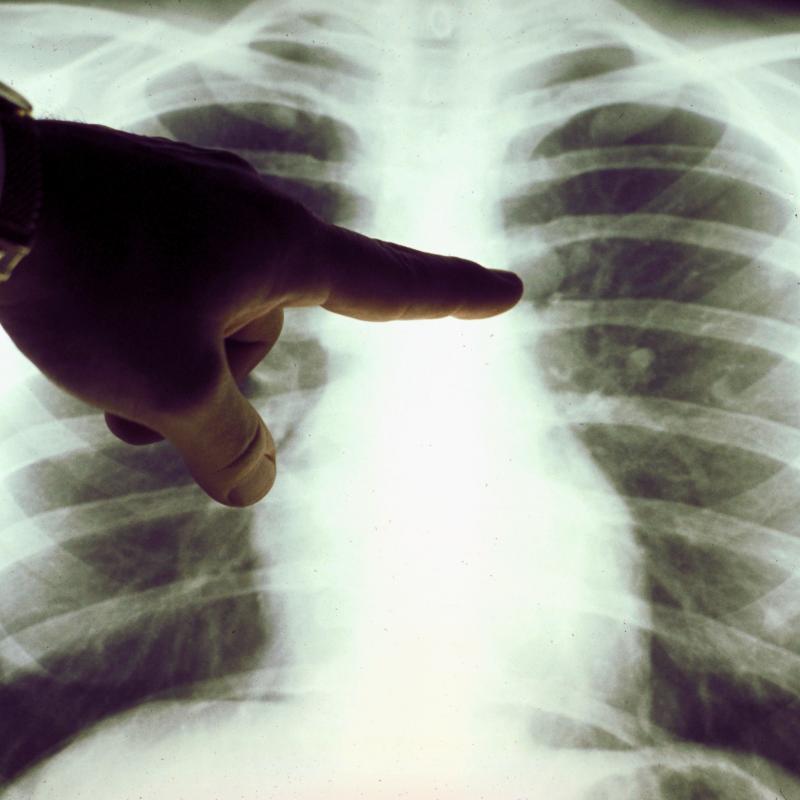
A doctor points a finger at a chest x-ray that shows the ribs

Health & Medicine

Filter by

Select Topics

Select Air Date

to

Select Segment Types

Segment Types

1,306 Segments

Sort:

Newest

18:35

Stress and Health.

Dr. Esther Sternberg from the National Institute of Mental Health and National Institutes of Health. In her new book “The Balance Within: The Science Connecting Health and Emotions” she looks at how researchers have uncovered the connection between mind and body.

Interview
42:23

Mount Everest's Doctor.

Kenneth Kamler, MD is a surgeon who also climbs mountains. He was team doctor on three expeditions to the top of Mount Everest, including the disastrous 1996 trip during which 6 people died. Kamler is both storyteller and advisor in his book, “Doctor on Everest: Emergency Medicine at the Top of the World – A Personal Account including the 1996 Disaster.” (The Lyons Press) Blackened limbs due to severe frostbite were the least of his troubles. I-V fluids are frozen solid, and abrasions cannot heal at such high altitudes.

Interview
44:50

Bill Moyers Discusses Death and Dying.

Bill Moyers has a new PBS series about death and dying, but the focus isn't just on dying; it's on trying to live a decent life in the face of death and on the movement to improve care at the end of life, such as new approaches to pain relief and hospice care. The series also examines some of the difficult personal and medical choices faced by people who are dying and their loved ones. The series is called "On Our Own Terms." It premieres Sunday evening on most PBS stations and continues over the next three consecutive nights.

Interview
42:22

Writer Jim Knipfel Discusses His Latest Memoir.

Writer Jim Knipfel. His first book, the acclaimed memoir Slackjaw (Putnam), is his funny, irreverent account of loosing his sight and trying to take his life. In his new book, Quitting the Nairobi Trio (Tracher/Putnam), he writes about the time he spent in a psychiatric ward. The New York Times says Knipfel is “blessed with a natural, one might even say reflexive, knack for telling stories.” Knipfel is a columnist and staff writer for New York Press.

Interview
07:32

AIDS in South Africa.

We talk more about HIV and AIDS in South Africa with journalist Phillip Van Niekerk (fawn-KNEE-kirk). Recently, the president of South Africa, Thabo Mbeki (TAH-boh mm-BEK-eh) has become very involved in the AIDs policy in his country. Mr. Mbeki is focusing on a medical theory that states that the human immunodeficiency virus, or HIV, does not cause AIDS. Many leading scientists have criticized MR. Mbeki for wasting his time on what they see as a discredited theory about AIDS. The International AIDS conference is scheduled to be held in South Africa this summer.

18:45

Peter Berg Discusses the Controversy Over "Wonderland."

Actor, writer, director and producer Peter Berg. He is the creator and executive producer of the new controversial ABC series Wonderland. The show is set in a mental hospital. Some call it the most accurate portrayal of the mentally ill on network television, while some mental health organizations say that the series further stigmatizes mental patients. As an actor, Peter Berg has started on the TV show Chicago Hope, and has appeared in movies like The Last seduction, Copland, and the Great White Hype.

Interview
21:26

A New Approach to Sports Psychology.

We will talk about the psychology of sports and athletes with Doctor Michael Miletic. He is one of the few psychoanalysts currently treating active professional athletes. Miletic serves as a psychiatric consultant to the Detroit Pistons, several professional Hockey teams, and the parents group of the National Football League Players Association. Miletic himself was an athlete. He was even a member of the Canadian Olympic weight lifting team, until an injury cut his career short.

Interview
38:45

Jerome Groopman Discusses "Second Opinions."

Jerome Groopman, MD. His new book is "Second Opinions: Stories Of Intuition And Choice In A Changing World Of Medicine." (Viking) The Harvard Medical School doctor and researcher says patient and doctor should be working together, using intuition, cutting-edge science and personal values to make critical medical decisions. The book's case histories include Goodman’s infant son, who was misdiagnosed in a hospital emergency room and almost died.

Interview
43:53

Bringing Clarity to Food and Nutrition.

Dr. Andrew Weill specializes in holistic medicine. He's the author of the bestseller "Spontaneous Healing." His new book is "Eating Well For Optimum Health: The Essential Guide to Food, Diet, and Nutrition" (Knopf). Weill is the founder of the Foundation for Integrative Medicine in Tucson, Arizona. His website is www.drweil.com

Interview
05:09

The Difficult Legacy of AIDS in World Music.

With the recent death of Israeli singer Ofra Haza to AIDS, World music critic Milo Miles reflects on the world musicians who have died of the disease, and the secrecy that surrounded their illnesses.

Commentary
21:43

Medical Errors in Hospitals.

Dr. Mark Chassin ("cha" as In "CHAT"-sin) Is the co-author of a report on medical mistakes In our nation's hospitals. This week In response to that report, President Clinton ordered that all U.S. hospitals take measures to reduce their errors. The report, Issued by the Institute of Medicine late last year, shook up patients and practitioners alike. It estimated that between 44,000 and 98,000 Americans die each year as a result of medical errors. The study was based on two studies In three states: New York, Utah, and Colorado.

Interview
40:32

The Problems in Family Caregiving.

Director of the United Hospital Fund's Project on Family Caregiving in an Age of Change, Carole Levine (Leh-VEEN). She brings her professional and personal life to bear on her work with the project: Since 1990, when her husband was critically injured in an automobile accident, she has been his caregiver. The Fund released a major new report on caregivers last month:"Rough Crossings: Family Caregivers' Odysseys through the Health Care System." Levine is also the founder and executive director of The Orphan Project: Families and Children in the HIV Epidemic.

Interview
20:47

"The Blood of Strangers."

Writer and Emergency doctor Frank Huyler (HIGH-ler). Huyler has transformed his experiences working in emergency rooms and hospitals into a series of short stories. His new book is called "The Blood of Strangers: Stories from Emergency Medicine (University of California Press)." His poetry has appeared in a number of publications including the Atlantic Monthly.

Interview
27:48

Transplant Recipient James Redford.

Executive producer, James Redford, of the new HBO documentary, "The Kindness of Strangers." The film tells the story of four organ transplant patients, and the donors and their families.. It premieres on HBO Sept 23rd. Redford, himself, underwent two liver transplants. He's also the son of actor Robert Redford. And he founded The James Redford Institute for Transplant Awareness in Los Angeles (www.jrifilms.org) (THIS INTERVIEW CONTINUES THRU THE END OF THE SHOW).

Interview
21:29

Navajo Surgeon Dr. Lori Arviso Alvord.

Dr. Lori Arviso Alvord is the first Navajo woman surgeon. She is the author of the new book "The Scalpel and the Silver Bear." (Bantam) In her practice, she combines modern surgery with ancient Navajo healing practices. Born and raised on a reservation near Gallup, New Mexico she now serves as an assistant professor of surgery at Dartmouth Medical School in Hanover, New Hampshire.

Interview
43:34

Lori B. Andrews Discusses "The Clone Age."

Lori B. Andrews is one of America's leading legal experts in the field of advanced reproductive technologies. These include cloning, surrogate motherhood, and harvesting human eggs and sperm. She is a professor at Chicago-Kent College of Law. Her latest book is "The Clone Age: Adventures in the New World of Reproductive Technology." (Holt Publishing) She has been a consultant on reproductive issues to The World Health Organization, U.S. Congress, and the National Institutes of Health. She lives in Chicago.

Interview
14:00

Preventing Heart Disease: The Role of Bacteria.

Immunologist at the Ontario Cancer Institute in Toronto, Josef Penninger. He recently led a study on the link between bacterial infection and heart disease. The study focused on the chlamydia bacteria which 95% of people are exposed to during their lives. The study suggests that heart disease can be prevented by treatment of antibiotics. The study was reported in the journal Science in February.

Interview
13:52

Preventing Heart Disease: The Role of Emotional Health.

Dr. Dean Ornish discusses the link between emotional health and prevention and treatment of heart disease. His new book is "Love & Survival: 8 Pathways to Intimacy and Health." (HarperPerennial). Ornish is Clinical Professor of Medicine at the School of Medicine, University of California, San Francisco and founder of the Osher Center for Integrative Medicine.

Interview

Did you know you can create a shareable playlist?

Advertisement

There are more than 22,000 Fresh Air segments.

Let us help you find exactly what you want to hear.
Just play me something
Your Queue

Would you like to make a playlist based on your queue?

Generate & Share View/Edit Your Queue