
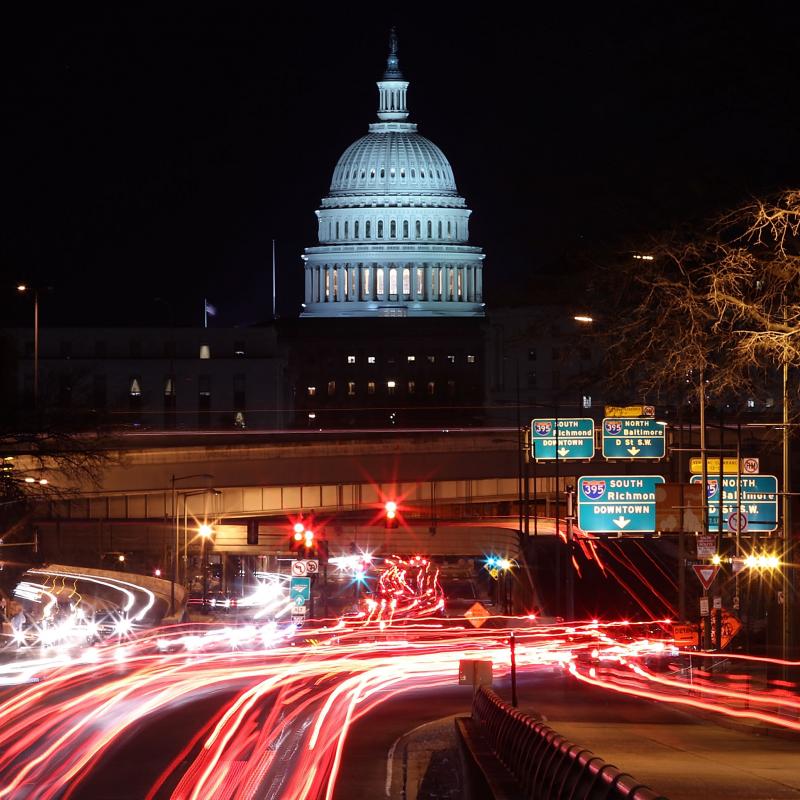
Nighttime view of the US Capitol building with a time-lapse of cars speeding by below

Government & Politics

Filter by

Select Topics

Select Air Date

to

Select Segment Types

Segment Types

4,520 Segments

Sort:

Newest

21:25

Planning the Next Phase of the Gulf War

First, reporter Pat Ford talks with retired Admiral Eugene Carroll, of the Center for Defense Information. They examine latest developments in the Gulf War. He'll speculate on what was discussed at this weekend's meeting between Secretary of Defense Dick Chaney, Chief of Staff Colin Powell, and commanding general Norman Schwarzkopf.

Then, Terry talks with the Science Advisor to King Hussain of Jordan, Doctor Abdullah Toucan. They'll discuss the environmental consequences of the Gulf War in light of Saddam Hussein's threat to destroy oil fields.

22:31

Monitoring Human Rights in the Middle East

We look at the state of human rights in the region--particularly in Iraq before the start of the Gulf War--as well as elsewhere around the world. Kenneth Roth, the deputy director of Human Rights Watch, shares his insights.

Interview
09:48

Syria's Growing Role in the International Drug Trade

We talk about United States' newest Middle East ally's involvement in the international drug trade with Philadelphia Inquirer reporter David Zucchino. Zucchino covers the drug war for the paper, and has spent two years in the Middle East. He also won a Pulitzer for his coverage of South Africa.

Interview
22:01

The Connection Between Oil Wealth and the Middle East Crisis

Fresh Air producer Amy Salit interviews Joe Stork, the editor-chief of "Middle East Report." He'll discuss the unequal distribution of wealth in the Middle East. Kuwait's has a strong economy tied to their oil production; their reluctance to share it with other, poorer, Arab countries has been cited as one of the motives behind Iraq's invasion.

Interview
22:13

The Psychological Trauma of War Veterans

Psychiatric-social worker Raymond M. Scurfield is the Director of the Post Traumatic Stress Disorder Program at the American Lake V.A. Center in Washington State. He served in Vietnam, treating psychiatric casualties. He talks about the typical problems found in combat, the dilemma of sending G.I.'s back into battle, and he speculates on the difficulties G.I.s will face in the Gulf.

22:42

Mohammad Mehdi on Misunderstandings Between the East and West

Mehdi is the Secretary General of the National Council on Islamic Affairs and President of the American-Arab relations committee. Born in Bagdad, he moved to the U.S. in the late 1940s. He talks with Terry about his frustration with the U.S.'s destructive actions in his home country, and about the strong link between the Islamic faith and the law.

22:15

A Path to Peace Through Negotiation, Catching up With China

Two interviews in this segment: First, Terry talks with Roger Fisher, the head of the Harvard Negotiation Project. He explains why it's still not too late to negotiate with Saddam Hussain. Then Terry speaks with journalist and long-time China watcher, Orville Schell; they'll discuss the current trials of some of the leaders of the student-led, pro-democracy movement.

21:24

Foreign Correspondent Thomas Friedman on the Gulf War

The New York Times reporter has spent the last decade covering the Middle East. In light of the start of the Gulf War, he has two questions -- How will we know when we win? And how will the war affect the peace process between Israel and Palestine? Friedman is the author of the bestselling book From Beirut to Jerusalem.

Interview
06:53

New Songs with Mixed Messages about the War

Rock critic Ken Tucker reflects on some recent songs that have come out in favor of or against U.S. involvement in Iraq, including those by Sean Lennon, Hank Williams, Jr., Andrew Tippin, and Randy Newman.

Commentary
06:34

On Music's Message of Peace

After seeing a performance the night the Gulf War began, classical music critic Lloyd Schwartz tells us about how music can be a poignant response to war.

Commentary
21:28

How Civilian Inequalities Lead African Americans to the Military

Ed Dorn, a senior staff member of the Brookings Institution, considers the question, "Does the US military really provide equal opportunities for African Americans?" Dorn points to the fact that blacks make up a disproportionately large percentage of the Armed Forces, in part because many African American recruits have fewer economic opportunities in the civilian world.

Interview
21:10

Black Perspectives on the War in Iraq

Terry speaks with three guests about how African Americans are engaged with the Gulf War. Diane Pinderhughes is a professor of Political Science at the University of Illinois and the author of a new report for the National Urban League on the role of blacks in the Gulf War. Damu Smith, the founder of the peace group, the African-American Network Against US Intervention in the Gulf, talks about the social forces that lead many African American to military service. Muhamad Abdul-Aleem is resident Imam of a Philadelphia Mosque.

16:47

The Military's Inconsistent Policies on Openly Gay Service Members

Journalist Randy Shilts wrote the controversial book on the handling of the AIDS crisis, "And the Band Played On." He joins Fresh Air to discuss the legal troubles gays and lesbians in the military face. Shilts says the provision against gays serving in the military has been ignored now that the U.S. is engaged in war, and that these service members potentially face court martial when they return.

Interview

All Subtopics

Did you know you can create a shareable playlist?

Advertisement

There are more than 22,000 Fresh Air segments.

Let us help you find exactly what you want to hear.
Just play me something
Your Queue

Would you like to make a playlist based on your queue?

Generate & Share View/Edit Your Queue