
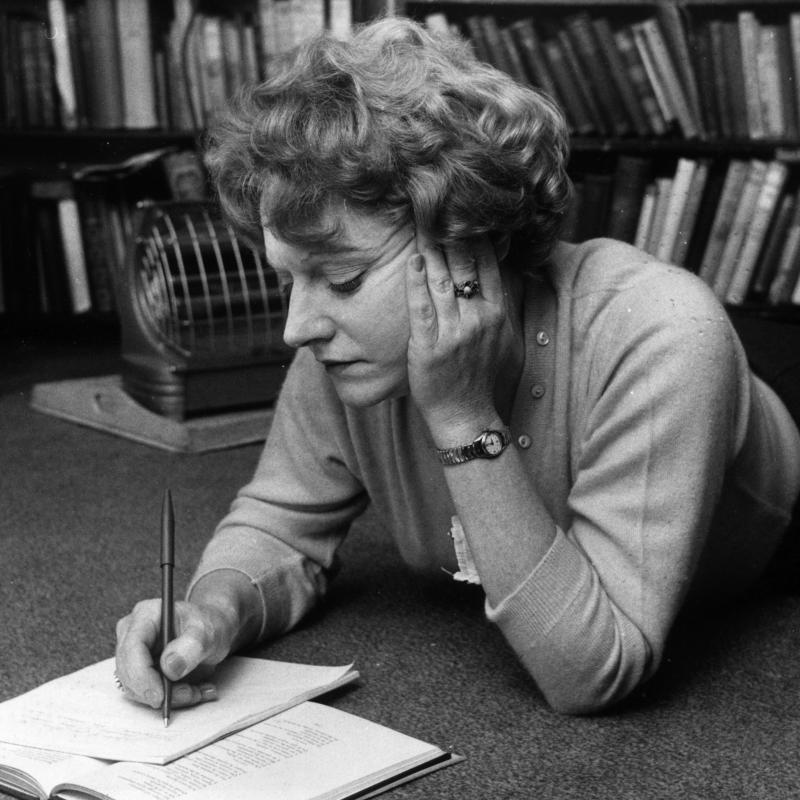
Author Muriel Spark writing

Books & Literature

Filter by

Select Topics

Select Air Date

to

Select Segment Types

Segment Types

5,401 Segments

Sort:

Newest

22:42

Walking Into the Heart of the Los Angeles Riots.

Gregory Alan-WIilliams, Emmy Award winning actor, author and playwright. He has written "A Gathering of Heroes, Reflections on Rage and Responsibility," a memoir of the Los Angeles Riots (Academy Chicago Publishers). On April 29, 1992, Alan-WIilliams, an African American, heard that violence had erupted in South Central L.A. and chose to walk into the heart of the riot. He ended up risking his own life to rescue a Japanese American man who was being brutally beaten by some in the angry crowd.

22:42

A History of the Reproductive Rights Movement.

David Garrow is a Pulitzer Prize winning author for his biography of Martin Luther King, Jr., "Bearing the Cross." His newest book is a history of the struggle for birth control rights during the 1920s and 30s and how that paved the way for the abortion rights struggle. Along the way, Garrow examines how these rights are tied in with issues of privacy and sexuality. Garrow found that the arguments used in the birth control rights struggle were the same ones used in the struggle for abortion rights.

Interview
16:58

Writer Shirlee Taylor Haizlip.

Writer Shirlee Taylor Haizlip. Her book "The Sweeter the Juice: a Family Memoir in Black and White, (Simon & Schuster), chronicles her exploration of six generations of her multiracial family tree. Haizlip is a light-skinned African-American. Her father was a prominent black Baptist minister in Connecticut. Her mother was the descendant of an Irish immigrant and a mulatto slave.

15:20

The Nature of Physical Intimacy with Robert Olen Butler.

Robert Olen Butler is the 1993 Pulitzer Prize winner in fiction for "A Good Scent From a Strange Mountain," (Henry Holt & Co.) a collection of 15 first-person stories by Vietnamese immigrants living in Louisiana. Butler has written seven novels in all, several of them dealing with the Vietnamese experience, in Vietnam and in America. Butler's latest book is "They Whisper," (Henry Holt), about intimacy between a man and a woman.

Interview
22:47

Gerry Conlon and Jim Sheridan Discuss "In the Name of the Father."

Author and former British prisoner, Belfast-born Gerry Conlon. In his memoir, "In the Name of the Father," he tells the story of his wrongful conviction and fifteen-year imprisonment by the British Government for the 1974 terrorist bombings of two pubs near London. He was in prison with his father, Giuseppe, who was also falsely convicted as a co-conspirator in the bombings.

22:28

James Trefil Discusses Cities as Ecosystems.

Physicist James Trefil. His new book, "A Scientist in the City," (Doubleday) is a exploration of how the laws of nature and technology came together to make our cities. Trefil starts by looking at cities as natural ecosystems, and then looks at the key scientific discoveries that made cities possible. Trefil has written more than ten books on science, including, "1001 Things Everyone Should Know About Science." Trefil is also a regular commentator for NPR, and he teaches at George Mason University.

Interview
22:04

How Did the U. S. Get So Gun Crazy?

Journalist Erik Larson of the Wall Street Journal. Larson has been on the show before to talk about polling, privacy and direct marketing and about how a gun goes from the manufacturer to the hands of a teenager. In fact he's written a new book, "Lethal Passage: How the Travels of a Single Handgun Expose the Roots of America's Gun Crisis," (Crown Publishers). Today Terry will talk again with Larson about guns, about gun control laws, the NRA, etc. Larson is also the author of "The Naked Consumer: How Our Private Lives Become Public Commodities."

Interview
11:59

Novelist Stephen Wright.

Novelist Stephen Wright. He's written three novels, all described by one critic as creating a "bleak vision of America haunted by Vietnam, desperate with boredom, eager to kill, gaga over flying saucers, addled by drugs, lobotomized by television." Wright's latest novel is "Going Native," (Farrar Straus Giroux) about a serial killer who seems to come from out of nowhere. In fact, he emerges out of a suburban neighborhood, steals a car, and heads for California.

Interview
22:48

The Republican "Face of AIDS."

Mary Fisher was the face of AIDS/HIV at the Republican National Convention in 1992 where she gave a speech imploring the party to lift the "shroud of silence" about the disease. Fisher comes from a wealthy prominent Republican family. Her father, Max Fisher was Honorary Chairman of the Bush/Quayle '92 National Finance Committee. Since she went public about her HIV-positive status, Fisher has been an eloquent voice in the fight against AIDS misinformation and discrimination. She's also the founder of the Family AIDS Network, Inc.

Interview
40:27

War Correspondent Peter Arnett.

War correspondent and CNN's international correspondent Peter Arnett. He's best known for his reporting from Baghdad during the allied bombing raid which heralded the start of the Gulf War. Arnett has over 30 years of experience reporting, mostly for the Associated Press. He won a Pulitzer for his coverage of the Vietnam war . Later he covered wars in Cyprus and Lebanon. In 1981 he made the switch to television, when he joined CNN. After learning the ropes, he was sent to El Salvador, Moscow, and then Iraq.

Interview
15:41

Television Mogul Pat Weaver.

The former head of NBC's television programming Pat Weaver (Sylvester L. "Pat" Weaver, Jr.). He began that job in the early days of the medium - in 1949 - and was the creator of two of television's longest running shows, the "Today" show and the "Tonight" show. Weaver started his career in radio, where he worked with comic Fred Allen. And he was advertising manager for the American Tobacco Company, under the eccentric tobacco magnate George Washington Hill. Weaver has a new memoir of his career, "The Best Seat in the House," (Knopf).

Interview
22:22

The "Detective of Death."

Medical Examiner and "detective of death", Michael Baden, the former Chief Medical Examiner of New York City. Baden argues that there is a national crisis in forensic medicine. He writes that the search for scientific truth is often sullied by the pressures of expediency and politics. His memoir is "Unnatural Death: Confessions of a Medical Examiner" (Ivy Books).

Interview
23:25

Harry Wu Discusses his Time in "China's Gulag."

Harry Wu is a resident scholar at the Hoover Institution at Stanford University. He came to the U.S. from China where he was held in a prison labor camp for 19 years. The son of a wealthy banker, Wu was a newly graduated college student when he was arrested in 1960 and denounced as an "enemy of the revolution." In the camps he endured torture, starvation, and he learned to "stop thinking in order to survive." In 1979 he was released.

Interview
16:00

The Anger and Pain of the Black Middle Class.

Contributing Editor and essayist for Newsweek magazine Ellis Cose. His new book, "The Rage of a Privileged Class: Why are Middle-Class Blacks Angry? Why Should America Care?" (HarperCollins) is about what many middle-class blacks feel, but few white americans understand: that middle-class blacks still struggle against racial stereotyping, discrimination, and alienation, despite their financial success and their best efforts to "play by the rules." Cose argues that many white americans make assumptions about Blacks which are at odds with reality.

Interview
21:32

The Origins of the Universe.

Astrophysicist George Smoot. Since 1974 he's worked on NASA's Cosmic Background Explorer (COBE) satellite, leading the instrument team that detected cosmic "seeds." In 1992 he announced that he and a team of researchers had detected the biggest, oldest objects ever observed in the universe, the "cosmic seeds" that were the origin of galaxies and clusters of galaxies.

Interview
23:20

Poet and Novelist Michael Ondaatje.

Poet and novelist Michael Ondaatje. He won Britian's highest literary prize, the Booker Prize, for his novel set in post World War II, "The English Patient," (Vintage Books). Ondaatje was born in Cyelon (now Sri Lanka), emigrated to England, and now lives in Canada. He also has written a personal memoir, "Running in the Family," (Vintage) about his eccentric family. Both books are now out in paperback. (Interview by Marty Moss-Coane)

Interview
16:21

Dr. Jon Kabat-Zinn Discusses Meditation and Mindfulness.

Dr. Jon Kabat-Zinn is a pioneer in the area of behavioral medicine. Since 1979 he has used Eastern "mindfulness meditation" techniques in treating chronic pain, stress, and life-threatening disease. He founded the Stress Reduction Clinic at the University of Massachusetts Medical Center in Worcester, Mass. His clinic was featured in Bill Moyer's PBS series, "Healing and the Mind." Kabat-Zinn's new book is "Wherever You Go There You Are: Mindfulness Meditation in Everyday Life." (Hyperion).

Interview

Did you know you can create a shareable playlist?

Advertisement

There are more than 22,000 Fresh Air segments.

Let us help you find exactly what you want to hear.
Just play me something
Your Queue

Would you like to make a playlist based on your queue?

Generate & Share View/Edit Your Queue