
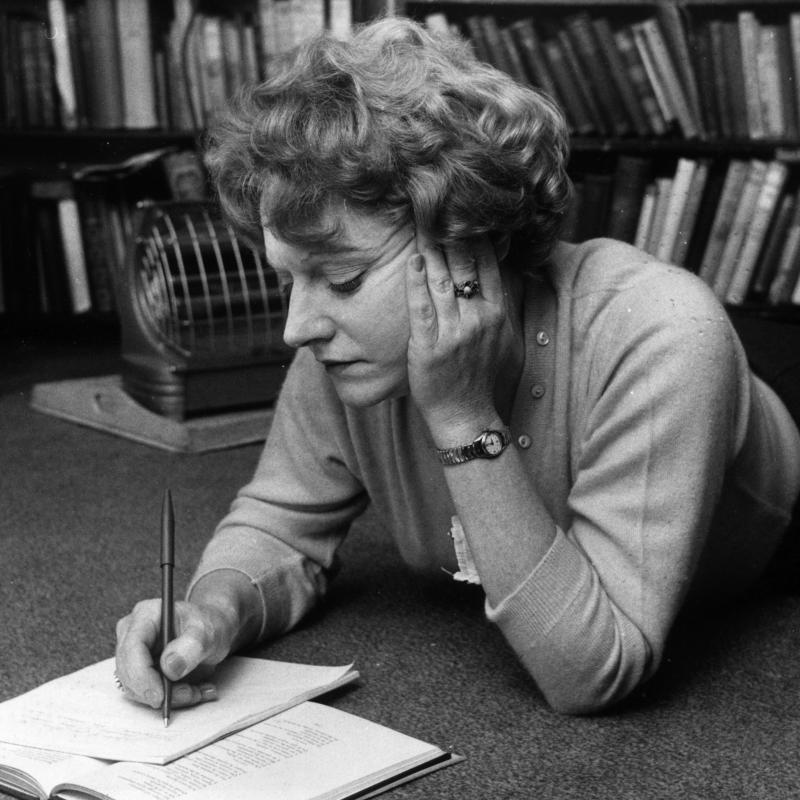
Author Muriel Spark writing

Books & Literature

Filter by

Select Topics

Select Air Date

to

Select Segment Types

Segment Types

5,401 Segments

Sort:

Newest

11:21

Writer Pagan Kennedy.

Writer for the Village Voice and The Nation Pagan Kennedy. Kennedy ("Pagan" is not her real first name) has staked out a niche for herself as a "1970's survivor and devotee." Kennedy has written an investigation of that decade, seen through its artifacts and social upheaval, "Platforms: A Microwaved Cultural Chronicle of the 1970's" (St. Martins). In the 70's she says, "we inherited this idea of recycling culture.

Interview
11:58

One of the Greatest of Living Newspaper Men.

Columnist and commentator Murray Kempton. The New Yorker says he's "surely among the greatest of all living newspapermen" . . . "the one true original in the business." For years he wrote a column for the old New York Post. Now he writes for New York Newsday and The New York Review of Books. At 76, he bicycles around Manhattan in his elegant attire to gather material for his columns on the City's "rebels, losers and rascals." His latest book is a collection of his newspaper pieces.

Interview
22:49

Death and Bodies.

Physician and author Kenneth Iserson, M.D. Iserson wanted to promote organ and tissue donation. So he wrote a book about what happens to dead bodies. It's called "Death to Dust" (Galen Press). Iserson believes that death is the pornography of our culture. He says that after-death activities are shrouded in secrecy. His book explores the mundane--burial choices and advance directives--and the arcane--head shrinking, cannibalism and cryonic preservation.

Interview
14:05

Gloria Steinem Reflects on Aging.

Writer, feminist, organizer, and the founder of Ms. Magazine, Gloria Steinem. She has a new book of essays, "Moving Beyond Words, (Simon & Schuster). In one of the essays she wonders -- what if Freud were female? -- and imagines what life would be like if one of the most "enduring, influential, and fiercely defended thinkers" in Western civilization were Dr. Phyllis Freud. In her new book Steinem also reflects on turning 60.

Interview
16:14

Marshall Crenshaw Brings His Guitar to Illustrate His Guide to Rock and Roll Films.

Rock musician Marshall Crenshaw. According to The New York Times, many critics have ranked Crenshaw"among the finest rock artists of the last dozen years." Now he has written a book. It's a reference guide to Rock 'n' Roll in the movies ("Hollywood Rock" HarperPerennial). According to his longtime bass player Graham Maby, Crenshaw has an encyclopedic knowledge of rock music. And he knows about the rock and roll movie genre from first-hand experience. He played Buddy Holly in the 1987 movie "La Bamba" about musician Ritchie Valens.

Interview
16:26

How Does Ethnic Pride Turn Into Ethnic Conflict?

Writer Michael Ignatieff, who has investigated six of the world's trouble spots for a BBC television series, and a companion book: "Blood & Belonging: Journeys into the New Nationalism" (Farrar, Straus & Giroux). A Canadian of Russian ancestry who lives in England, Ignatieff's book raises the question of why nationalism, which once unified countries like Germany and Italy, today pulls countries apart.

Interview
21:22

Moving the Detective Novel to the Suburbs.

Journalist and mystery writer Jon Katz. Katz is a media critic, . formerly for Rolling Stone and now for New York Magazine. First in Katz's "Death by Station Wagon" (Bantam) and now in his newly released "The Family Stalker" (Doubleday), soft boiled detective hero Kit Deleeuw cruises the streets of a fictional suburban community on crime-solving forays in his Volvo station wagon. Deleeuw lost his Wall Street job in the 80's.

Interview
05:09

A Love Story From Both Points of View.

Commentator Maureen Corrigan reviews "Bengal Nights," and "It Does Not Die," two autobiographical novels about the same romantic affair. They've just been republished. "Bengal Nights" is by Mircea Eliade, "It Does Not Die," is by Maitreyi Devi. (Both University of Chicago Press).

Review
17:34

Recovered Memories and Crime.

Journalist and author Lawrence Wright. Wright's latest book is "Remembering Satan: A Case of Recovered Memory and the Shattering of an American Family" (Knopf) Wright explores the nature of memory and the notions of recovered memory and repression. "Remembering Satan" is the story of Paul Ingram and his family. Ingram was a Washington state deputy sheriff. His two grown daughters accused him of sexually abusing them. They said that Ingram and other members of the sheriff's department had committed Satanic ritual atrocities.

Interview
04:35

New Book Explores the Difficulties of Biography.

Commentator Maureen Corrigan reviews "The Silent Woman: Sylvia Plath and Ted Hughes" by Janet Malcolm (Knopf). The book is a reflection on the various attempts by biographers to chronicle the life of the late poet Sylvia Plath.

Review
22:13

Author Carlos Fuentes Discusses the Disturbing Events in Mexico.

Mexican author Carlos Fuentes. Mexico is in flux. On New Years Day, a violent peasant uprising broke out in Chiapas, and thru negotiations, the Zapitistas (as they call themselves) reached a tentative agreement with the government. Then frontrunner presidential candidate Luis Donaldo Colosio was assassinated as he campaigned in Tijuana. The Mexican government says at least seven people conspired in the killing. Fuentes will discuss recent events in Mexico and the history that shaped them.

Interview
45:17

Milos Forman Discusses His Life and Career.

Film director Milos Forman. Originally from Czechoslovakia, Forman is the director of such American films as "One Flew Over the Cuckoo's Nest," "Amadeus," "Hair," and "Ragtime." Forman began his film career in his native country, apprenticing with some of the country's best film makers for the Communist state-controlled film industry.

Interview
22:35

Looking at Jesus Historically.

Professor John Dominic Crossan. A native of Ireland, ordained as a priest in the U.S. (he left the Priesthood in 1969), Crossan now teaches biblical studies at DePaul University. Crossan is a founding member of the Jesus Seminar, a group of scholars who meet to determine the authenticity of Jesus' sayings in the Gospels. Crossan's new work is "Jesus: A Revolutionary Biography" (HarperCollins) which seeks to place Jesus in the context of his Jewish, Mediterranean and peasant roots; to see him as a Socratic philosopher and radical egalitarian.

15:52

Colombian Journalist Maria Jimena Duzan.

Colombian journalist Maria Jimena Duzan helped expose the connection between Colombia's drug traffickers and the nation's military in 1988. Duzan and her paper, El Espectador, were the targets of death threats and attacks. By 1990 all of the members of the paper's former investigative unit were either dead or in exile. Duzan went into exile, but her sister, a documentary film maker, was murdered. Duzan returned to Columbia in 1992. She has a new book, "Death Beat: A Colombian Journalist's Life Inside the Cocaine Wars." (HarperCollins)

10:00

Author Jervey Tervalon.

Author Jervey Tervalon. He has written a first novel, titled "Understand This" (William Morrow and Company, Inc.). Tervalon set "Understand This" in today's South Central Los Angeles where he grew up and returned after college to teach in a public high school. He believes life is much more difficult in South Central L.A.--and everywhere in America--now. Tervalon's characters are faced with often overwhelming, life and death decisions.

Interview

Did you know you can create a shareable playlist?

Advertisement

There are more than 22,000 Fresh Air segments.

Let us help you find exactly what you want to hear.
Just play me something
Your Queue

Would you like to make a playlist based on your queue?

Generate & Share View/Edit Your Queue