
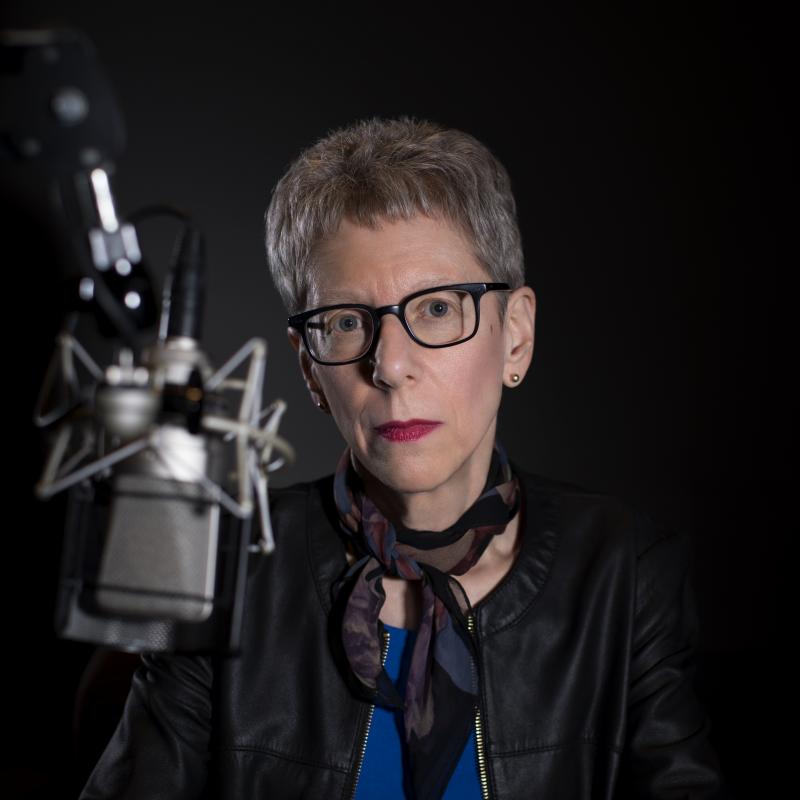
Terry Gross at her microphone in 2018

Terry Gross

Terry Gross is the host and an executive producer of Fresh Air, the daily program of interviews and reviews. It is produced at WHYY in Philadelphia, where Gross began hosting the show in 1975, when it was broadcast only locally. She was awarded a National Humanities Medal from President Obama in 2016. Fresh Air with Terry Gross received a Peabody Award in 1994 for its “probing questions, revelatory interviews and unusual insight.” America Women in Radio and Television presented her with a Gracie Award in 1999 in the category of National Network Radio Personality. In 2003, she received the Corporation for Public Broadcasting’s Edward R. Murrow Award for her “outstanding contributions to public radio” and for advancing the “growth, quality and positive image of radio.” Gross is the author of All I Did Was Ask: Conversations with Writers, Actors, Musicians and Artists, published by Hyperion in 2004. She was born and raised in Brooklyn, NY, and received a bachelor’s degree in English and M.Ed. in communications from the State University of New York at Buffalo. She began her radio career in 1973 at public radio station WBFO in Buffalo, NY.

Sort:

Newest

31:10

Law & Disorder: New Orleans Police, Post-Katrina.

An ongoing investigation by PBS' Frontline, The Times-Picayune and ProPublica examines the many violent incidents that took place between police officers and civilians in the aftermath of Hurricane Katrina. Reporter A.C. Thompson recounts the difficulties of trying to piece together the details.

Interview
43:42

Queen's Brian May Rocks Out To Physics, Photography.

After writing "We Will Rock You" and touring around the world as the lead guitarist in Queen, Brian May made an unusual career choice: He got his Ph.D. in astrophysics. May explains how Queen developed its distinctive sound and explains his fascination with stereoscopic photographs taken in the 1850s.

Interview
44:23

Gary Shteyngart: Finding 'Love' In A Dismal Future.

His third novel, Super Sad True Love Story, is a black comedy set in a futuristic America — where books don't exist and where the economy has collapsed. Shteyngart explains why he decided to write a love story in this dystopic vision of the future — and why he thinks technology is changing the way we think.

Interview
21:15

Dr. Atul Gawande: Make End Of Life More Humane

Technology can prolong the lives of the terminal ill -- but at what cost? Surgeon and New Yorker writer Atul Gawande examines the difficulties for medical professional and families who must decide when to stop medical intervention and focus on improving a patient's last days.

Interview
42:25

Ousted Evangelical Reflects On Faith, Future

In December 2008, the Rev. Richard Cizik was forced to resign from his position in response to comments he made on Fresh Air in support of same-sex civil unions. He returns to the show to discuss how his life has changed -- and why he believes evangelicals need to change, too.

Interview
45:06

Reporter's View: How The WikiLeaks Story Developed

Reporter Mark Mazzetti was one of several reporters from The New York Times who sifted through the 92,000 secret military documents leaked by WikiLeaks. He explains how the Times worked to verify the information in the documents -- and what the information means for the future of the war in Afghanistan.

Interview
37:58

Robert Duvall: From 'The Godfather' To 'Get Low'

The Academy Award-winning actor details some of his most memorable roles, including his portrayal of Tom Hagen in The Godfather and Lieutenant Colonel Bill Kilgore in Apocalypse Now. He also describes his latest role, a hermit planning a "living funeral," in the upcoming film Get Low.

Interview
44:21

What The Financial Bill Did And Didn't Do

President Obama calls the bill "the most far-reaching reform since the Great Depression." But the measure leaves the financial industry "substantially intact," while putting more federal "lifeguards ... around the pool," Binyamin Applebaum of The New York Times says.

Interview
21:21

Malaria: The 500,000-Year-Old 'Fever' That Won't Die

If public health officials know how to prevent malaria, the mosquito-borne pathogen that kills more than a million people each year, why isn't more being done to eradicate the infectious disease? That's the question journalist Sonia Shah decided to answer in her book, The Fever, which examines why malaria continues to spread around the globe.

Interview

Did you know you can create a shareable playlist?

Advertisement

There are more than 22,000 Fresh Air segments.

Let us help you find exactly what you want to hear.
Just play me something
Your Queue

Would you like to make a playlist based on your queue?

Generate & Share View/Edit Your Queue