
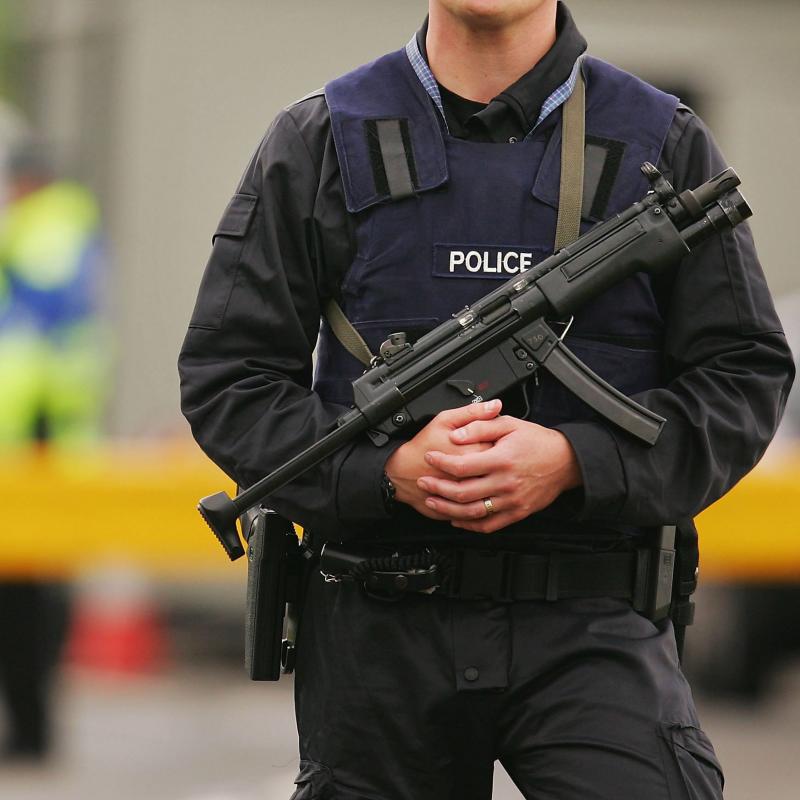
Police officer with a gun

Crime & Law Enforcement

Sort:

Newest

46:45

A Survivor of Gang Life Looks Back on His Violent Past

Poet, journalist, and critic Luis Rodriguez's new book, "Always Running: La Vida Loca, Gang Days in L.A." is about his participation in gang life in the 1960s in East L.A., which began at age 12. By the time he was 18, 25 of his friends had been killed. After a stint in the county jail, Rodriguez turned his back on that lifestyle. He became involved in the Chicano movement, and was encouraged to write. "Always Running," is in part an attempt to save his 16-year-old son Ramiro from gang life. Ramiro joins the conversation later in the segment.

18:11

The Therapeutic Value of "Confronting Evil"

Two individuals involved with the Victim/Offender Mediation Program (with The Community Dispute Resolution Center in New York City): Program Director Thomas Christian, and Gary Geiger, who was shot and wounded during a robbery eleven years ago. Through the program, Geiger confronted the man who shot him, Wayne Blanchard, who is now in prison. Their meeting is featured in the HBO special, "Confronting Evil: America Undercover."

22:24

A Son Grapples with HIs Father's Violence

Author Lorenzo Carcaterra is managing editor of the CBS weekly series "Top Cops." He's written a memoir, "A Safe Place," about growing up, the son of a violent, loving, murderous, and generous father. They lived in New York's Hell's Kitchen during the 50s and 60s. Lorenzo found out at the age of 14 that his father had murdered his first wife when she threatened to leave him. Lorenzo's father went on to terrorize his second wife, beating her and Lorenzo. Yet his father also could be warm and affectionate to his family.

Interview
21:44

The Rise of Guns and Gun Deaths in the United States

Journalist Erik Larson's article, "The Story of a Gun," is the cover story on this month's issue of "The Atlantic." It tells the tale of what happens with a gun, beginning with the maker, to the dealer, and to the murderer who uses it. Larson claims there is a de facto conspiracy of gun dealers, gun manufacturers, and federal regulators, "which makes guns all too easy to come by and virtually assures their eventual use in the bedrooms, alleys, and school yards of America."

Interview
15:26

A Son Tries to Clear His Father's Name

Alger Hiss & his son Tony Hiss. This is the infamous Alger Hiss who was convicted and jailed in 1950 for perjury after denying, under oath, that he had been a Soviet spy. This past October, with the opening of Soviet archives, there was found to be no evidence that Hiss had ever been an agent of the Kremlin. Hiss is 88 years old now, and has maintained his innocence all along. His son, Tony Hiss is a staff writer at "The New Yorker," and he wrote about his father's ordeal and exoneration in the November 16 issue of the magazine.

22:47

Curtailing Gun Violence in the African American Community

Counselor Alvin Cater founded the Al Carter Foundation at Cabrini Green, a housing project in Chicago of 6000 people. The foundation is a hands-on intervention program that reaches youth by going into the streets, and makes referrals to the 13 human service agencies within Cabini Green. He tells Terry about the recent truce brokered among gangs at the project, and the effect recent gun violence has had on the community.

Interview
16:53

George Anastasia on the Next Generation of Mobsters

Anastasia is a reporter for the Philadelphia Inquirer. His beat is the Mafia; most recently he's been covering the Robert Simone trial where the prosecution rested its case today. Simone was attorney for Philadelphia mob boss Nicky Scarfo and has been accused of crime activity, attempted extortion and participating in discussions of murder. Simone was turned in by a government informant.

Interview
46:10

Prison Journalist Wilber Rideau

Since 1975, Rideau has been the editor-in-chief of "The Angolite," the prison newsmagazine of the Louisiana State Penitentiary, where he's serving a life sentence for murder. An eighth-grade dropout, he was convicted of murder in 1961 and spent eleven years on death row at Angola, where he taught himself to write. "The Angolite" has highlighted issues of execution and prison rape. For his writing, Rideau won the Sidney Hillman Award in 1981, the George Polk award in 1980, and the Robert F.

Interview

Did you know you can create a shareable playlist?

Advertisement

There are more than 22,000 Fresh Air segments.

Let us help you find exactly what you want to hear.
Just play me something
Your Queue

Would you like to make a playlist based on your queue?

Generate & Share View/Edit Your Queue