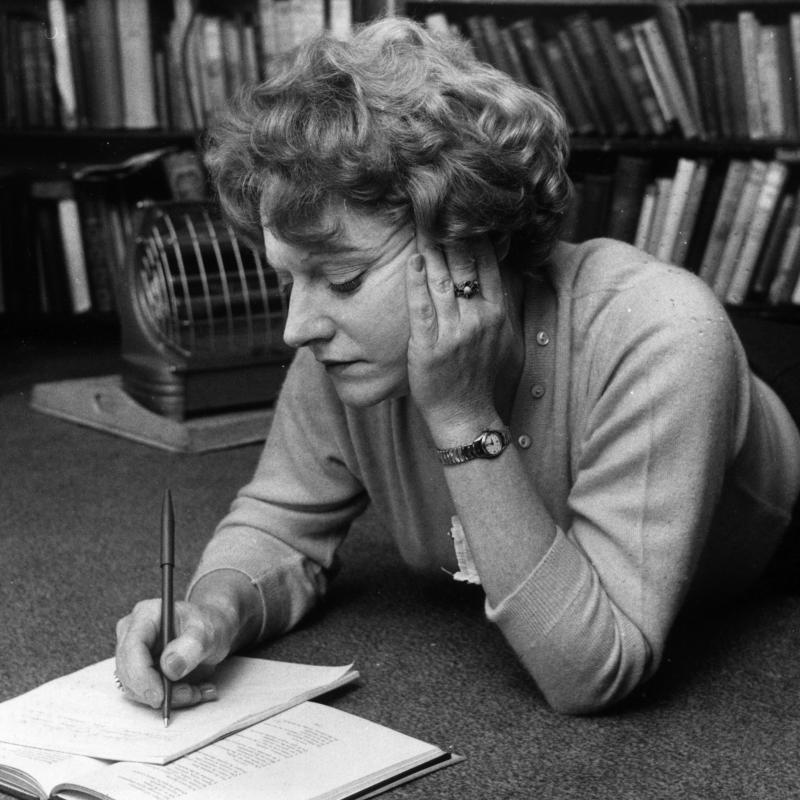
Author Muriel Spark writing

Books & Literature

Filter by

Select Topics

Select Air Date

to

Select Segment Types

Segment Types

5,421 Segments

Sort:

Newest

22:31

Michael Dorris Discusses Fetal Alcohol Syndrome.

Writer Michael Dorris. He and his wife, Louise Erdrich, have written several novels together, including Love Medicine and Yellow Raft in Blue Water. Both are part Native American, and Dorris spent several years of his childhood on an Indian reservation. He has adopted many children, one of which he later discovered was born with fetal alcohol syndrome. Dorris's new book, The Broken Cord, is about this syndrome, and also his personal story of dealing with it in his family.

Interview
10:22

Mary Kay Blakely Shares What It's Like to Be in a Coma.

Writer Mary Kay Blakely. In 1984, shortly after a divorce, a recent diagnosis of diabetes, the suicide of a brother and a series of missed deadlines in her job as a journalist, Blakely collapsed into a coma. The coma lasted nine days, and when Blakely awoke, she saw the coma as a signal that the crush of commitments and societal pressures had overwhelmed her body, that "the life she planned no longer fit the woman she had become." Blakely writes about her journey back from her coma and her decision to redirect her life in her book Wake Me When It's Over.

Interview
22:36

Michael M. Baden Discusses the Insights to be Gleaned from Autopsies.

Medical examiner Michael M. Baden. In his new book, Unnatural Death: Confessions of a Medical Examiner, Baden, the former chief medical examiner for New York City, reviews the record of famous autopsies of the last 30 years as evidence of a pattern of bungled investigations of unnatural deaths. Baden, who has been a medical examiner for 30 years, views his profession as a historian or anthropologist who revisits ruined or questionable autopsies in the hopes of correcting history. Baden is now director of the forensic sciences unit for the New York State Police.

Interview
22:06

Amy Wilentz Discusses the Politics and Government of Haiti.

Journalist Amy Wilentz. Her first book, The Rainy Season, Haiti since Duvalier, is an account of Haiti since the overthrow of President-for-Life Jean-Claude "Baby Doc" Duvalier, and of how the country's hope for reform gave way to despair when it was clear Haiti's new leadership couldn't, or wouldn't, reverse 40 years of chaos and stagnation. The book is also an account of how Wilentz was transformed by the story, of how the epochal change Haiti was going through, and its stunning contrast of poverty and corrupted wealth, overwhelmed her first assumptions.

Interview
10:56

Novelist Cynthia Kadohata on Her Nomadic Novel and Childhood.

Novelist Cynthia Kadohata. Her first novel, The Floating World, is a `road novel' about a second generation Asian American teenager who leads a nomadic life with her parents as her father travels the country from one job to the next. As her journey unfolds, the protagonist struggles to find her place in her family and in America. Kadohata's short stories have appeared in The New Yorker and the quarterly The Pennsylvania Review. (Interview by Marty Moss-Coane)

Interview
22:49

How Ignorance of Their Bodies and Sex Allowed a Doctor to Assault Women for Years.

Writer Jack Olsen. He's been called a master of the `true crime' genre, and in his new book, Doc, he tells the story of how Dr. John Story, one of the most respected citizens of Lovell, Wyoming, systematically raped his patients, and how, in this ultra-conservative, God-fearing environment, the women either couldn't speak up, or, when they did, were dismissed. Lovell is set in Mormon country, and many of the women the doctor victimized feared excommunication for "fornication" if they when to the authorities, who, invariably, were also elders in the Mormon church.

Interview
11:16

Allan Gurganus on Memory and Race.

Writer Allan Gurganus. His novel, Oldest Living Confederate Widow Tells All, which is scheduled for publication later this fall, is the story of a blind 99-year-old widow, now confined to a nursing home, whose stories about her life and her husband's take in almost 150 years of American history. Mostly her stories focus on her husband and how his experiences in the Civil War, when he was only 13, haunted him, and her, until he died. Gurganus, a professor of writing at New York's Sarah Lawrence University, has written for The New Yorker, Harpers and The Atlantic Monthly.

Interview
11:08

"Wendel" Comic Sparks Discussion of Gay Male Identity.

Cartoonist Howard Cruse. He draws a comic strip called "Wendel" that follows the life of a young gay man. The strip is a regular feature in the gay and lesbian newsmagazine The Advocate. Recent "Wendel" strips have just been collected in the book Wendel On The Rebound, published by Saint Martin's Press.

Interview
22:59

The Solidarity Resistance Movement in Poland.

Journalist MICHAEL KAUFMAN. His new book, Mad Dreams, Saving Graces - Poland: A Nation in Conspiracy, charts the rise, fall and resurrection of the democratic movement in Poland. Leading this drive has been Solidarity, the shipworkers' union headed by Lech Walesa. But Kaufman also traces the hidden spiritual undercurrents in Polish history and culture and that make this quest toward self-definition considerably more complex. Kauffman served as Warsaw bureau chief for The New York Times from 1984 to 1987. He has also been bureau chief for the Times in Nairobi, New Delhi and Ottawa.

Interview
18:31

Larry Sultan's Family Album.

Photographer Larry Sultan. In a photography exhibit now on display at the Museum of Modern Art in New York City, Sultan is represented by work from a project he began in 1983 about his family's history. A key feature of the work, and a feature that appears in all of Sultan's work, is capturing subjects at "off" moments, situations where they least expect, or wish, themselves to be photographed.

Interview
11:05

The Thrill of Finding Oil.

Author Rick Bass. His new book, Oil Notes, is a journal based on Bass' experience as a geologist looking for oil throughout the American West. Bass has also written short stories, essays, and environmental journalism.

Interview
22:20

Simon Schama's Controversial but Well-Written Chronicle of the French Revolution.

Historian and writer Simon Schama. His revisionist history of the French Revolution - Citizens: A Chronicle of the French Revolution - has been one of the most talked-about and debated volumes of history in the last several years. Critics have lauded Schama for bringing vividly to life the characters that inspired the five-year popular uprising that changed the modern political order.

Interview
23:07

May Sarton Discusses Solitude and Mythology in Her Writing.

Writer May Sarton. For many readers, Sarton is a heroic figure for her decision to expose her lesbianism in the early 60s, long before it society was tolerant of the gay life, and also for her decision to lead a life of solitude. The author of over 35 novels, books of poetry and essays, Sarton is probably best known for her journals, Recovering, and At Seventy. Her most recent book of poems, The Silence Now, explores themes from the solitude of the aging, to AIDS, to world peace.

Interview
22:16

David Brinkley Discusses His Career and New Book.

Veteran TV journalist David Brinkley. His book, Washington Goes to War, was a surprise best-seller last year and has just been released in paperback. The book, based on Brinkley's personal experiences and reflections, told the story of Washington in the early 40s, and how both the government and town itself were transformed by the responsibilities thrust on them as a result of the war.

Interview
10:56

Writer and Feminist Barbara Wilson.

Feminist writer Barbara Wilson (sometimes Barbara Sjoholm). She's a co-founder of the feminist publishing house, Seal Press. She also writes detective novels whose heroine is a lesbian feminist detective. Her latest novel, The Dog Collar Murders, offers a humorous look at the debates between the S&M and anti-porn factions of the feminist community.

Interview
27:08

Arlie Hochschild on "The Second Shift"

The feminist scholar looks at how women in dual-career partnerships are often responsible for most of the unpaid domestic work. Hochschild joins Fresh Air to discuss why men don't share this labor equally with their partners, and the toll this inequity takes on working women.

09:27

For Ian Frazier, the Great Plains are a "Giant Time Park"

Writer Ian Frazier is known primarily as a humor writer for The New Yorker magazine. His new book, Great Plains, is describes a history of the region through Frazier's own trips driving 25,000 miles in a criss-cross of the area, and hours of research in the New York's Public Library.

Interview

Did you know you can create a shareable playlist?

Advertisement

There are more than 22,000 Fresh Air segments.

Let us help you find exactly what you want to hear.
Just play me something
Your Queue

Would you like to make a playlist based on your queue?

Generate & Share View/Edit Your Queue