
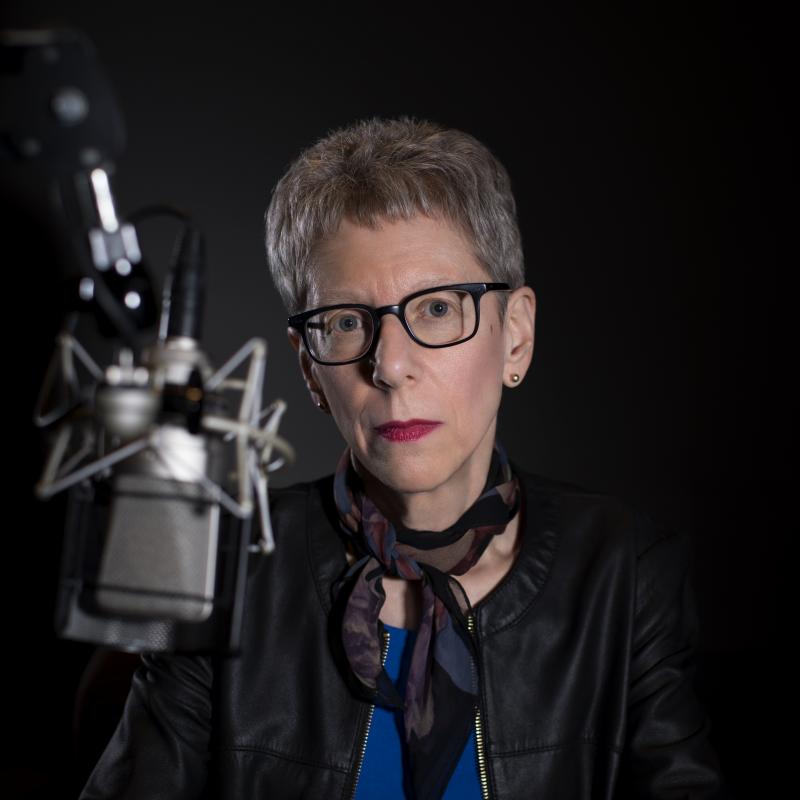
Terry Gross at her microphone in 2018

Terry Gross

Terry Gross is the host and an executive producer of Fresh Air, the daily program of interviews and reviews. It is produced at WHYY in Philadelphia, where Gross began hosting the show in 1975, when it was broadcast only locally. She was awarded a National Humanities Medal from President Obama in 2016. Fresh Air with Terry Gross received a Peabody Award in 1994 for its “probing questions, revelatory interviews and unusual insight.” America Women in Radio and Television presented her with a Gracie Award in 1999 in the category of National Network Radio Personality. In 2003, she received the Corporation for Public Broadcasting’s Edward R. Murrow Award for her “outstanding contributions to public radio” and for advancing the “growth, quality and positive image of radio.” Gross is the author of All I Did Was Ask: Conversations with Writers, Actors, Musicians and Artists, published by Hyperion in 2004. She was born and raised in Brooklyn, NY, and received a bachelor’s degree in English and M.Ed. in communications from the State University of New York at Buffalo. She began her radio career in 1973 at public radio station WBFO in Buffalo, NY.

Sort:

Newest

22:25

Salman Rushdie Discusses Fighting the Fatwa Against Him.

Controversial author Salman Rushdie. Terry last talked to him in late 1990 about his life. For over three years, Rushdie's been in hiding, a result of the reaction to his novel "The Satanic Verses." That novel offended many Muslims and led to the Ayatollah Khomeini putting a one-million-dollar death sentence on Rushdie's head. Just lately, he's begun to travel and make public appearances, even though he's still a target for assassination. Rushdie called us from his hiding place somewhere in Great Britain.

Interview
16:16

Frances Lear Discusses her Memoir.

Frances Lear founded Lear's Magazine. At one time she was married to TV producer Norman Lear, and though her life, from the outside, seems quite pleasant and successful, her new memoir "The Second Seduction" details a life full of pain.

Interview
23:12

Cinematographer and Director Ed Lachman.

Cinematographer and director Ed Lachman. He's shot films for many famous directors both in Europe and America, including Werner Herzog, Wim Wenders, Bernardo Bertolucci, Paul Schrader and David Byrne. He's also shot his own films and videos. He most recently worked on the new Hanif Kureishi film "London Kills Me."

Interview
15:26

Actress Christine Lahti Discusses Women in Hollywood.

Actress Christine Lahti. She starred in the movie "Housekeeping," co-starred with Goldie Hawn in "Swing Shift," which won her the New York film Critics Award as Best Supporting Actress, and is now in the new film "Leaving Normal." (Universal Pictures) She also has a long stage career, appearing in "The Heidi Chronicles." She talks about how hard it is for women to get good roles in Hollywood, and how she's turned many down because she didn't like the characters she'd be portraying.

Interview
22:22

Stan Sesser Discusses the Current Situation in Cambodia.

Stan Sesser, a staff writer at The New Yorker magazine, just wrote a lengthy article called "Report From Cambodia." A country that's been dirt poor for several decades is experiencing a new prosperity since the United Nations peace agreement was signed last October. Oddly, the agreement calls for a sharing of power with the Khmer Rouge, an action Sesser equates with allowing the Nazis back into power in post war Germany. (The article is in the May 18, 1992 issue of The New Yorker.)

Interview
15:47

Aram Saroyan Discusses his Memoir.

Writer Aram Saroyan ("AH-rum"). His father was William Saroyan; his stepfather is Walter Matthau. In the Sixties, he went through a minimalist poetry writing phase. Then he turned to autobiographical narrative, concentrating on his parents' turbulent marriage, his father's death, and his own family. His new book is called "Friends In The World: The Education of A Writer." (Coffee House press)

Interview
22:46

David Savage Discusses the Supreme Court.

David Savage is the Supreme Court reporter for the Los Angeles Times. He's just written a book called "Turning Right: The Making of the Rehnquist Supreme Court," (John Wiley and Sons) about how the Supreme court turned conservative in the 80s, and what future decisions the court will make.

Interview
22:48

"Men's Rights" Activists Robert Bly.

Robert Bly is one of the founders of the modern men's movement. He wrote the movement's most influential book, "Iron John." Terry asks him if the men's movement is in conflict with the women's movement. Robert Bly is also a poet, critic essayist and translator. (Bly's book "Iron John" is published by Vintage).

Interview
16:51

Black-Korean Conflicts in Los Angeles.

John Lee is a first-generation Korean reporter whose beat at the Los Angeles Times has been Koreatown during and since the riots. Many Korean merchants were targeted, and many wielded guns to defend themselves. He feels that the Korean side of the conflict hasn't been accurately portrayed by the media.

Interview
22:32

What We Can Learn from Tribal Societies.

Anthropologist David Maybury-Lewis. He's the founder of Cultural Survival, an organization that that helps indigenous peoples whose ways of life are threatened by development. He's hosting a new PBS series called "Millennium," which starts tonight, and he's the author of the companion book, also called "Millennium." The series and the book seek to gain tribal wisdom for the modern world. (The book is published by Viking.)

Did you know you can create a shareable playlist?

Advertisement

There are more than 22,000 Fresh Air segments.

Let us help you find exactly what you want to hear.
Just play me something
Your Queue

Would you like to make a playlist based on your queue?

Generate & Share View/Edit Your Queue