
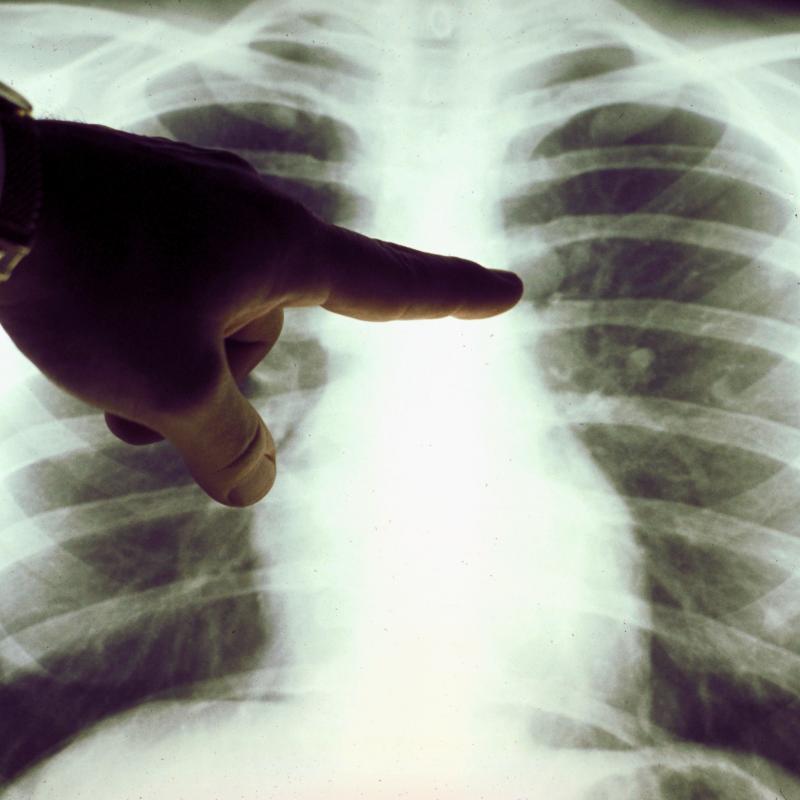
A doctor points a finger at a chest x-ray that shows the ribs

Medicine & Health

Filter by

Sort:

Newest

23:01

Pennsylvania Governor Robert P. Casey.

Pennsylvania Governor Robert P. Casey. June 14th will be the first anniversary of his "return from the dead." Last year when he was close to death from a fatal liver disease that was destroying his heart, Casey received a heart and liver transplant. The donor was a young African American man who was savagely beaten by drug dealers. Casey talks about his second chance at life. And he discusses his views--pre and post-surgery--on political issues of life and death such as abortion and the death penalty.

Interview
43:09

Treating AIDS in Tennessee.

Author and physician Abraham Verghese. An Indian raised in Ethopia, Abraham Verghese arrived in the United States in 1980 as a rookie doctor. Upon completing an internship in infectious diseases, Dr. Verghese accepted a position in the rural, Appalachian town of Johnson City, Tennessee. The year was 1985 and AIDS had begun to ravage large metropolitan areas. Within the year, Dr. Verghese was treating his first case of AIDS in this rural outpost.

Interview
22:49

Death and Bodies.

Physician and author Kenneth Iserson, M.D. Iserson wanted to promote organ and tissue donation. So he wrote a book about what happens to dead bodies. It's called "Death to Dust" (Galen Press). Iserson believes that death is the pornography of our culture. He says that after-death activities are shrouded in secrecy. His book explores the mundane--burial choices and advance directives--and the arcane--head shrinking, cannibalism and cryonic preservation.

Interview
15:58

Pharmacologist Dr. Avram Goldstein Discusses Addiction.

Pharmacologist Dr. Avram Goldstein. He set up some of the first methadone clinics to treat heroin addiction in California, and has a new book "Addiction: From Biology to Drug Policy" (Freeman). Goldstein argues that addictions are diseases, and must be considered a public health problem. A study released last month may back him up: 500,000 American deaths a year are attributed to cigarette, alcohol and drug use.

Interview
21:32

The Epidemic of Violence.

Violence prevention expert Deborah Prothrow-Stith. She's encouraged America to look at violence as a public health emergency. Stith says that instead of stitching up bullet wounds and returning people to the streets, we should teach violence prevention. Stith, assistant dean at Harvard School of Public Health, received the World Health Day Award in 1993. Stith co-wrote a book on violence called "Deadly Consequences" (Harper Collins) and a health textbook, "Health Skills for Wellness".

22:41

On Why We Shouldn't Be Complacent about AIDS.

Doctor Marcus Conant. In the early 1980's Dr. Conant was among the first doctors in San Francisco to treat AIDS cases. Now Dr. Conant heads the largest private AIDS medical practice in San Francisco. After his 1985 study on how condoms block transmission of the AIDS virus, condoms became a household word. Dr. Conant is the director of AIDS Clinical Research Center and the co-director of the Kaposi's Sarcoma Clinic at the University of California at San Francisco.

Interview
15:29

The Poor and Healthcare.

Health care reporter Laurie Kaye Abraham. For her new book, "Mama Might Be Better Off Dead: the Failure of Health Care in Urban America" (U of Chicago), Abraham spent three years with a poor African American family studying the problem of lack of access to medical care. Abraham reveals how difficult it is for a poor family to make sense of Medicaid and Medicare, and the discrimination that blacks face in trying to find health care.

Interview
13:51

Professor Marc Roberts Breaks Down the Clinton Health Care Plan.

Professor of Political Economy and Health Policy Marc Roberts. He's written a new book about the health care crisis: "Your Money or Your Life: The Health Care Crisis Explained." (Doubleday). Roberts will talk with Terry about Clinton's health care plan, which the president presented to Congress yesterday. Roberts is on the faculty at the Harvard School of Public Health and the John F. Kennedy School of Government.

Interview
44:39

Dr. David Spiegel Discusses Care for the Terminally Ill.

Dr. David Spiegel, a professor of psychiatry and behavioral sciences at Stanford University School of Medicine. His groundbreaking study of breast cancer patients showed that women who had psychosocial intervention lived twice as long, after diagnosis, as those without that intervention. His new book, "Living Beyond Limits" (Times Books) covers current research on mind/body interactions, how to build sustaining support networks, control pain through self-hypnosis and detoxify fears of dying.

Interview

Did you know you can create a shareable playlist?

Advertisement

There are more than 22,000 Fresh Air segments.

Let us help you find exactly what you want to hear.
Just play me something
Your Queue

Would you like to make a playlist based on your queue?

Generate & Share View/Edit Your Queue