
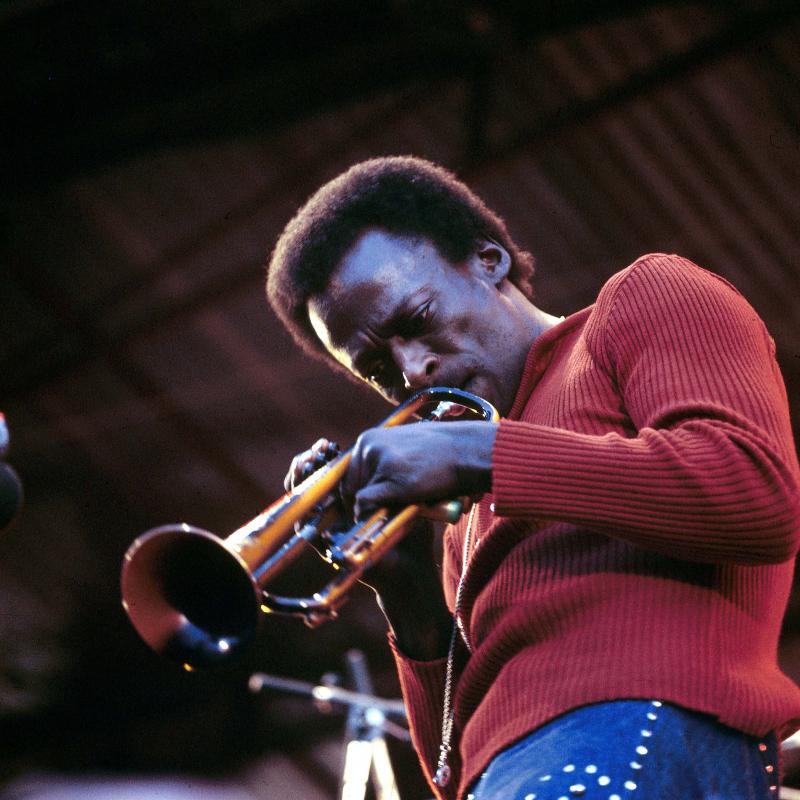
Jazz legend Miles Davis playing the trumpet in a red shirt

Jazz

Sort:

Newest

22:22

Rhythm and Blues Pioneer Johnny Otis.

Bandleader, singer, songwriter, and talent scout Johnny Otis. His musical career spans the big band era, rhythm and blues, and rock and roll. In the 40's he played and traveled with the big bands, with the Ink Spots and Louis Jordan. Later, with a pared down band, he was on the forefront of the rhythm and blues. He's credited with discovering Etta James, Big Mama Thornton, Jackie Wilson and Ernestine Anderson.

Interview
22:30

Jazz Vibraphonist Lionel Hampton Discusses His Life and Career.

Jazz vibraphonist Lionel Hampton. He introduced the vibes to the jazz world and remains one of it's undisputed masters. In the 1930's he played with the Benny Goodman's band -- being one of the first blacks to play with a white band. He's just written an autobiography, "Hamp." Al Capone and Louis Armstrong also play surprising roles in his life.

Interview
11:24

Using Contemporary Jazz to Chronicle Its Musical Journey From Africa to the Present Day.

Jazz composer/clarinetist John Carter. He has just completed a five part music series chronicling the black migration experience from Africa to America: "Roots and Folklore: Episodes in the Development of American Folk Music. The final program in the series, "Shadows on A Wall," premiered recently as part of the New Wave Festival at the Brooklyn Academy of Music. The festival celebrates performers working on the edge of classical, rock, and jazz styles. Carter's performances are also out on disc.

Interview
11:19

Jazz Legend Lester Bowie Interprets Rhythm and Blues.

Jazz trumpeter Lester Bowie. Bowie is considered one of the most original trumpeters in jazz, and a master of horn effects. Bowie started out playing with Saint Louis R&B bands. In 1969, he helped found the Art Ensemble of Chicago as an outlet for more eclectic and avant-garde jazz. Bowie also heads his own band, Lester Bowie's Brass Fantasy. They have a new album, called "Serious Fun."

Interview
11:43

Interview and Performance with the "Queen of the Boogie."

Pianist and singer Hadda Brooks. In the days following World War II, Brooks was a key figure in the West Coast jazz and blues scene. Her singing led to roles in movies and to a stint hosting a television show; she was the first black woman to earn that distinction. When her style of jazz and boogie woogie piano went into decline in the 50s, Brooks lived and performed overseas. She resumed her career in America in 1987, and was an immediate hit. She's currently appearing at Michael's Pub in New York City with singer Thelma Carpenter. (Interview by Sedge Thomson)

27:14

Jazz Singer Joe Williams

The Chicago-born Williams sang for the Count Basie Orchestra before beginning a solo career in 1962. In the 1940s, he suffered a nervous breakdown, unsure of what he wanted out of his professional life. After a year in the hospital, he returned to performing, and has a new album called In Good Company.

Interview
09:55

Jazz Bassist Buell Neidlinger

When he's not doing studio work, Neidlinger mostly performs the work of Duke Ellington and Thelonious Monk, both of whom he sees as two of the most important American composers. Classically trained on the cello, Neidlinger joined avant-garde pianist Cecil Taylor's band in the 1950s. Several of their albums have just been reissued.

Interview
09:12

A Big Sound from the Microscopic Septet

Joel Forrester and Phillip Johnston founded the NYC-based jazz combo. The group had trouble finding an audience early on, in part because of their unique blending of styles. Forrester and Johnston join Fresh Air to talk about their influences, and the logistics of keeping such a large group together.

27:45

Catching Up with Mercer Ellington

Band leader and composer Mercer Ellington is the son of Duke Ellington, and leads the Duke Ellington Band. As a young man, Mercer Ellington played trombone, French horn and trumpet in his father's ensemble. Two recent Mercer Ellington albums have won wide acclaim: "Digital Duke" and "For Ellington," performed by the Modern Jazz Quartet.

Interview
26:20

The Evolution of Swing

Critic and composer Gunther Schuller's new book, The Swing Era, examines the history of big band music. Though he is already a jazz enthusiast, Schuller says he researched his book as if he had no prior knowledge of the genre, hoping to craft a more comprehensive and objective account of that its development.

Interview

Did you know you can create a shareable playlist?

Advertisement

There are more than 22,000 Fresh Air segments.

Let us help you find exactly what you want to hear.
Just play me something
Your Queue

Would you like to make a playlist based on your queue?

Generate & Share View/Edit Your Queue