
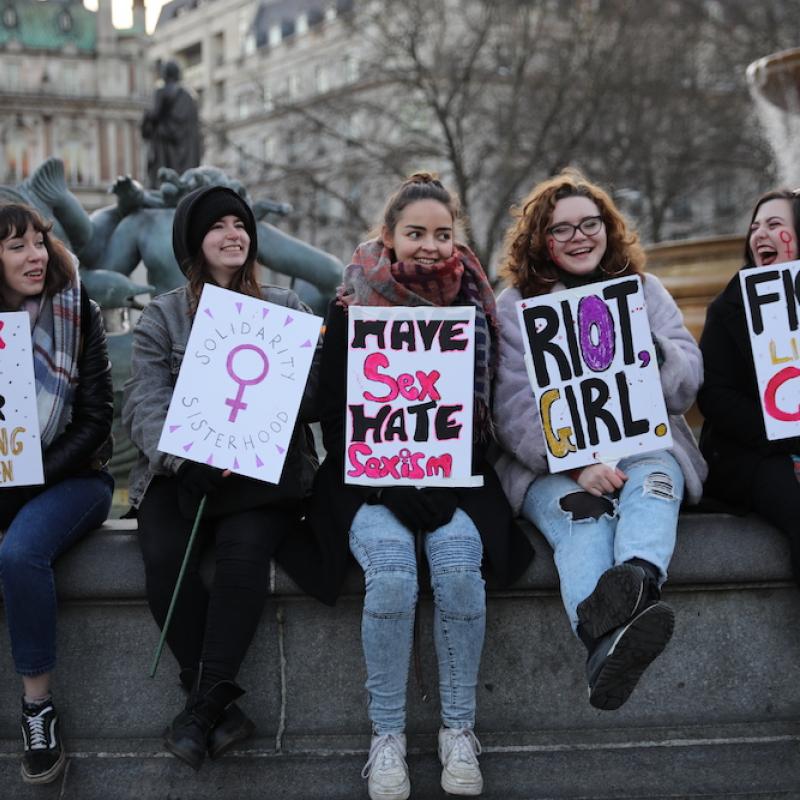
Young girls holding feminist signs at a protest

Feminism

Sort:

Newest

21:26

The Dilemmas of Being a Modern Woman.

Mary Gordon is the author of several bestselling novels which are often about the conflicts facing contemporary women. Her novels include "Final Payments" and "The Company of Women." She's also the author of the memoir, "The Shadow Man: A Daughter's Search for Her Father" (Vintage Books, paperback). Gordon's newest novel is "Spending" (Scribner) about a woman painter who finds a patron, muse, and lover in a wealthy commodities broker.

Interview
21:35

The First Second-Generation Feminist.

Historian Ellen Carol Dubois teaches at the University of California, Los Angeles. She's the author of the new biography: "Harriot Stanton Blatch and the Winning of Woman Suffrage" (Yale University Press). Blatch was the daughter of the famous suffragist Elizabeth Cady Stanton. When her mother died, Blatch carried on her mother's work, encouraging women of all classes to participate. Dubois also edited "The Elizabeth Cady Stanton-Susan B. Anthony Reader" (Northeastern University Press)

Interview
20:08

Spiritualism and Women's Rights.

Historian Barbara Goldsmith. Her new book is both biography and a history of the time. It tells the story of the 19th century feminist and spiritualist Victoria Woodhull, "Other Powers: The Age of suffrage, Spiritualism, and the Scandalous Victoria Woodhull" (Knopf). Victoria Woodhull was the first woman to run for president. She was an ardent feminist who championed for women's rights, but her spiritualism put her outside the mainstream suffrage movement, as well as her attempts to blackmail her enemies.

Interview
21:11

The Life of Jane Austen.

Claire Tomalin, author of the biography "Jane Austen: A Life" (Knopf). The biography addresses Austen's world, family, and works, many of which in recent years have inspired popular film versions. Tomalin is also the biographer of Mary Wollstonecraft and Nelly Ternan.

Interview
28:06

Women's Rights and Islam.

Mahnaz Afkhami, executive director of the Sisterhood is Global Institute (SIGI), and Azar Nafisi, professor of English Literature at Tehran's Tabatabai University discuss this weekend's Sisterhood is Global conference in Washington D.C., a symposium addressing issues such as cross-cultural education and women's rights on a global scale. Afkhami has written a substantial manual for women's rights education in Muslim countries. Nafisi has conducted ongoing workshops in Iran, one of six SIGI world workshop sites, on women, their identities, and their rights.

22:00

Margot Adler Discusses Her Life in the 60s.

NPR correspondent Margot Adler's commitment to political causes began in her childhood: she grew up in a household of communist sympathizers during the McCarthy era. As a student at Berkeley, she continued her activism. During this time, she exchanged letters with an American soldier in Vietnam. Her life in the sixties is the subject of her memoir, "Heretic's Heart: A Journey Through Spirit and Revolution." (Beacon Press) Adler is now an expert on witchcraft and paganism.

Interview
36:45

Performance Artist and Author Kate Bornstein on Rejecting the Gender Binary

In her books and plays Bornstein, a transgender activist, argues the need for the acceptance of nontraditional gender roles, meaning those not defined as either male of female. In her book "Gender Outlaw: On Men, Women, and the Rest of Us," she writes about her sex-change experience and her view of society's conceptions of gender. She has also written the novel (with co-author Caitlin Sullivan) "Nearly Roadkill."

Interview
16:03

Women's Place in the Early Church and Today

Jo Ann Kay McNamara talks with Terry Gross about her book "Sisters In Arms: Catholic Nuns Through Two Millennia." It is published by Harvard University Press. McNamara is a Professor of History at Hunter College and at the Graduate Center of the City University of New York.

Interview
21:15

Former Planned Parenthood President Faye Wattleton

Wattleton headed the organization from 1978 to 1992. She was raised in a fundamentalist Christian family (her mother was a minister), and later studied to be a nurse. Her work as a public-health nurse exposed her to the hardship of women who tried to terminate their pregnancies in the days before legal abortion. Wattleton went on to be executive director of the local Planned Parenthood, and then president of Planned Parenthood nationally. Her new memoir is called "Life on the Line"

Interview

Did you know you can create a shareable playlist?

Advertisement

There are more than 22,000 Fresh Air segments.

Let us help you find exactly what you want to hear.
Just play me something
Your Queue

Would you like to make a playlist based on your queue?

Generate & Share View/Edit Your Queue