
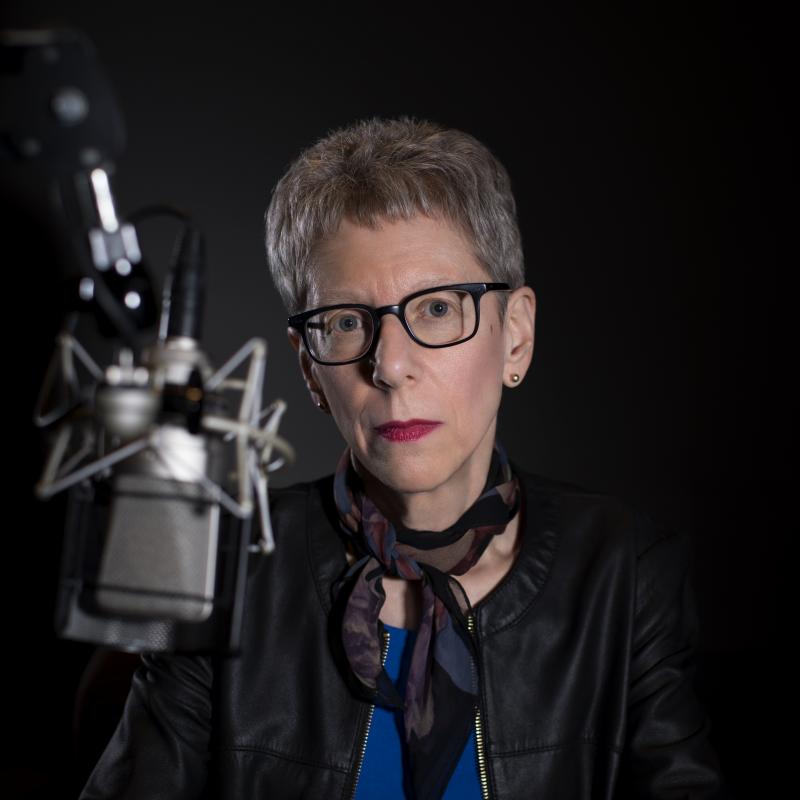
Terry Gross at her microphone in 2018

Terry Gross

Terry Gross is the host and an executive producer of Fresh Air, the daily program of interviews and reviews. It is produced at WHYY in Philadelphia, where Gross began hosting the show in 1975, when it was broadcast only locally. She was awarded a National Humanities Medal from President Obama in 2016. Fresh Air with Terry Gross received a Peabody Award in 1994 for its “probing questions, revelatory interviews and unusual insight.” America Women in Radio and Television presented her with a Gracie Award in 1999 in the category of National Network Radio Personality. In 2003, she received the Corporation for Public Broadcasting’s Edward R. Murrow Award for her “outstanding contributions to public radio” and for advancing the “growth, quality and positive image of radio.” Gross is the author of All I Did Was Ask: Conversations with Writers, Actors, Musicians and Artists, published by Hyperion in 2004. She was born and raised in Brooklyn, NY, and received a bachelor’s degree in English and M.Ed. in communications from the State University of New York at Buffalo. She began her radio career in 1973 at public radio station WBFO in Buffalo, NY.

Sort:

Newest

14:17

A History of Immigrants and Disease.

Holding immigrants responsible for various health epidemics has been an American pastime for two centuries argues Alan Kraut, Professor of History at American University. Just as the Irish were wrongly blamed for the cholera epidemic in the 1830's so too were Haitians in Miami branded as AIDS carriers in the 1980's. His new book "Silent Travelers: Germs, Genes, & the "Immigrant Menace"" (Basic Books) traces how immigration policy and health care have been affected by xenophobia and public fears of contamination. (Interview by Marty Moss-Coane)

Interview
22:53

Zlata Filipovic Discusses Being a Child in the Yugoslav War.

Zlata Filipovic is a thirteen year-old Sarajevan, whose diaries of the war in Bosnia have been published this month as "Zlata's Diary" (Viking). The book begins in August of 1991, with a new school year --fifth grade-- and the trappings of girlhood: piano lessons and tennis. By that spring, Sarajevo was under siege and Zlata's schoolmates were being killed, her family hiding in the basement and abandoned purebred dogs wandered the streets.

Interview
46:53

Surviving a Lynching.

Author and museum director James Cameron. Sixty four years ago, an organized mob of more than 10,000 white men and women dragged Cameron and two other black teenage men from a jail cell in Marion, Indiana. The mob mercilessly beat the three young men. They lynched two. Cameron was spared. In 1984, he recounted this experience in his memoir "A Time of Terror" (Available now from Black Classic Press). Then in 1988, Cameron founded the Black Holocaust Museum in Milwaukee.

Interview
16:22

Novelist Benjamin Cheever.

Novelist Benjamin Cheever. He's written a second novel, "The Partisan," (Atheneum). It follows on the heels of his first novel, "The Plagiarist." Both books are funny novels. Of his first, one reviewer wrote, "Wit and pathos, so finely meshed they become inseparable, buoy the main events in this achingly funny first novel. . . This is a touching, entertaining debut." Ben is the son of the late writer John Cheever. In writing his novels Ben said he finally found his own voice, separate from his father's.

Interview
23:13

Journalist Nguyen Qui Duc.

Journalist Nguyen Qui Duc. He works for KALW-FM in San Francisco, supplies commentaries to NPR and received the Overseas Press Club's 1989 Award of Excellence for his public radio series about returning to Viet Nam. Nguyen has written a new memoir about his family's struggle during and after the war. NGUYEN's father was an official in the South Vietnamese government who was captured by the Viet Cong and imprisoned for 12 years. In 1975, Nguyen gained passage to the U.S. on a cargo ship, and moved about from relative to relative until he settled in California.

16:39

Extremism and Violence in Israel.

Israeli political scientist Ehud Sprinzak. Sprinzak has written a book called "The Ascendance of Israel's Radical Right" (Oxford University Press 1991). He follows the emergence in Israel since 1984 of a radical right-wing movement shaped by religious fundamentalism, extreme nationalism and aggressive anti-Arab sentiment. Sprinzak believes that the influence of the radical right pervades Israeli politics and culture as well as Arab-Israeli relation. He sees Israel's radical right exercising increasing control over the Jewish settlements in the West Bank.

Interview
22:41

Comedienne Roseanne Discusses Her Life and Career.

Comedienne and superstar Roseanne Arnold. Her show "Roseanne" debuted in 1988 and has consistently been a top TV series. She has often made news--she forced out the show's executive producer in a dramatic confrontation, she went public with accusations of incest, she performed a controversial rendition of "The Star Spangled Banner" at a baseball game. In 1989, she published her first book, "Roseanne: My Life as a Woman" which became a best seller. Now she has written "My Lives" (Ballantine Books).

Interview
14:52

Linguist Steven Pinker Discusses the Instinct for Language.

Steven Pinker, a psycholinguist at MIT and director of its Center for Cognitive Neuroscience, has a new book on how language works: "The Language Instinct: How the Mind Creates Language" (Morrow). He argues that language is not simply a cultural invention taught by parents and schools, but a biological system, --an instinct-- partly learned, and partly innate. To Pinker, a three year old toddler is a "grammatical genius", capable of obeying adult rites of language, similar to web-spinning in spiders or sonar in bats.

Interview
23:18

Exploring the World of People with Autism.

Donna Williams. Her first book "Nobody Nowhere" offered a journey through the mysterious condition of autism; it was an international bestseller. Once her case was properly diagnosed, Williams began therapy which took her out of the "world under glass" and into the real world of speech and emotion. This treatment is the subject of her new book "Somebody, Somewhere: Breaking Free from the World of Autism" (Times Books).

Interview
45:49

Update on the Situation in Bosnia.

Journalist Misha Glenny. Glenny has been covering the war in former Yugoslavia--first as correspondent for the BBC and now as an independent journalist. He is the author of the book "The Fall of Yugoslavia." He will talk about the recent mortar attack on the market in Sarajevo and the effects of the recent downing by NATO forces of four Serbian warplanes.

Interview

Did you know you can create a shareable playlist?

Advertisement

There are more than 22,000 Fresh Air segments.

Let us help you find exactly what you want to hear.
Just play me something
Your Queue

Would you like to make a playlist based on your queue?

Generate & Share View/Edit Your Queue