
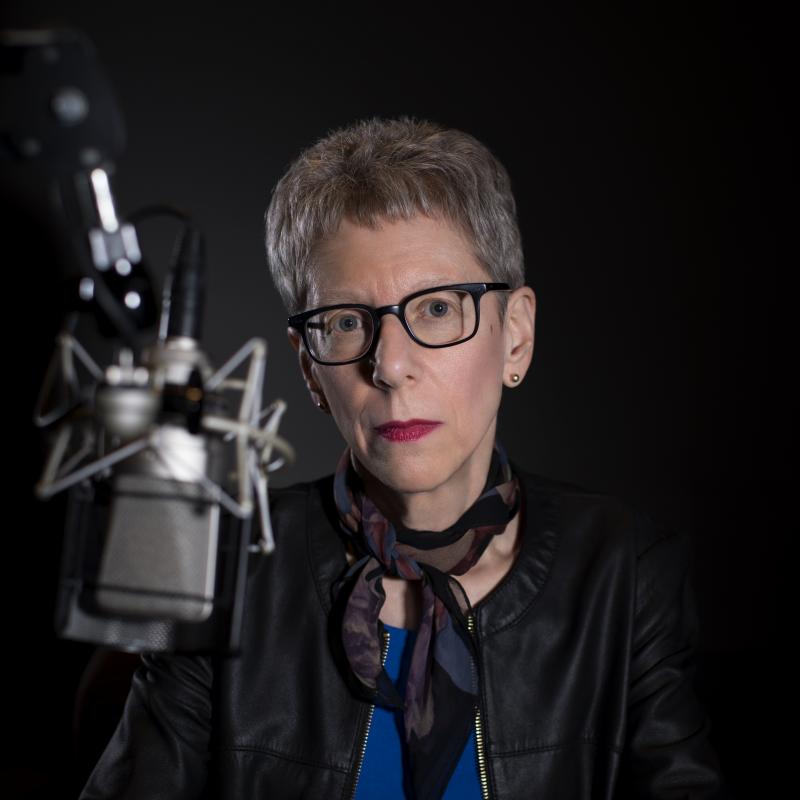
Terry Gross at her microphone in 2018

Terry Gross

Terry Gross is the host and an executive producer of Fresh Air, the daily program of interviews and reviews. It is produced at WHYY in Philadelphia, where Gross began hosting the show in 1975, when it was broadcast only locally. She was awarded a National Humanities Medal from President Obama in 2016. Fresh Air with Terry Gross received a Peabody Award in 1994 for its “probing questions, revelatory interviews and unusual insight.” America Women in Radio and Television presented her with a Gracie Award in 1999 in the category of National Network Radio Personality. In 2003, she received the Corporation for Public Broadcasting’s Edward R. Murrow Award for her “outstanding contributions to public radio” and for advancing the “growth, quality and positive image of radio.” Gross is the author of All I Did Was Ask: Conversations with Writers, Actors, Musicians and Artists, published by Hyperion in 2004. She was born and raised in Brooklyn, NY, and received a bachelor’s degree in English and M.Ed. in communications from the State University of New York at Buffalo. She began her radio career in 1973 at public radio station WBFO in Buffalo, NY.

Sort:

Newest

13:47

Albert Mohler

Christian missionaries — mainline and evangelical — want to go to Iraq to provide humanitarian aid. But their presence would be troubling for many Muslims who are suspicious that aid is just a cover for another motive — converting Muslims to Christianity. We talk with two individuals with opposing views on the subject: Albert Mohler is a minister and president of The Southern Baptist Theological Seminary. He's considered a leader among American evangelicals. Southern Baptists are pledging to go into Iraq to provide humanitarian aid.

Interview
18:07

Jazz pianist Matthew Shipp

He's part of the free-jazz movement in New York City (along with saxophonist David S. Ware, bassist William Parker and violinist Mat Maneri). One of his influences has been avante-garde pianist Cecil Taylor. Shipp's style has been described as "a distinctive combination of Mr. Taylor's percussive attack and Chopin's languid rubatos." He's been recording since the early 1990s, and has over 20 albums to his credit as leader and sideman. Since 1999, Shipp has been artistic director the Thirsty Ear Records' Blue Series.

Interview
20:57

Dr. Morton Rostrup

Rostrup is the international president of the medical relief organization Doctors Without Borders. He was the organization's medical coordinator in Baghdad. Rostrup just returned from five weeks in Baghdad. He was there before and during the war.

Interview
28:59

Journalist Philip Hilts

He's a longtime correspondent on health and science policy for The New York Times. In his new book, Protecting America's Health: the FDA, Business, and One Hundred Years of Regulation, he chronicles the history of the Food and Drug Administration from its start during the administration of Teddy Roosevelt. Hilts also broke the now-famous story of the Brown and Williamson tobacco industry papers, and is the author of Smoke Screen: The Truth Behind the Tobacco Industry Cover-Up.

Interview
20:49

Bob Koester

Founder and owner of the Chicago-based jazz and blues label Delmark, Bob Koester. The label celebrates its 50th anniversary this year. Artists Junior Wells, Little Walter, Big Joe Williams, Coleman Hawkings, Muhal Richard Abrams and Sun Ra & The Arkestra have all recorded on the label. Delmark has issued a 50th-anniversary collection.

Interview
38:39

Author Diane Ravitch

Ravitch is the author of the new book, The Language Police: How Pressure Groups Restrict What Students Learn. In her book she chronicles the efforts of school boards and bias and sensitivity committees to edit and shape the textbooks that end up in classrooms. Some examples of this include: omitting the mention of Jews in an Isaac Bashevis Singer story about prewar Poland, changing the expression "My God!" to "You don't mean it," and recommending that children not be shown as disobedient or in conflict with adults.

Interview
45:10

Historian Margaret MacMillan

She is professor of history at the University of Toronto and the author of the new book, Paris 1919: Six Months That Changed the World, about the Peace Conference after World War I in which delegations from around the world convened to find an alternative to war. During the six months of the conference, new boundaries were drawn up in the Middle East. Out of that conference Iraq was born, and was for a time under British control. MacMillan's book, published under the title Peacemakers in England, was the winner of the Samuel Johnson Prize.

Interview
42:36

Author Jonathan Schell

In his new book, The Unconquerable World: Power, Nonviolence, and the Will of the People, he rethinks the relationship between war and political power. Schell writes that military power is not as effective as it once was, and that a more useful approach is one of cooperation with other nations. Schell is also the author of the 1982 classic The Fate of the Earth. He has written for The Nation, The New Yorker, Harper's Magazine and The Atlantic Monthly.

Interview
22:49

Alex Berenson

Alex Berenson is a financial investigative reporter for the New York Times. In his new book The Number: How the Drive for Quarterly Earnings Corrupted Wall Street and Corporate America, Berenson examines the corporate scandals at Worldcom, Halliburton, Computer Associates, Tyco, and others, looking at practices that were common to all.

Interview

Did you know you can create a shareable playlist?

Advertisement

There are more than 22,000 Fresh Air segments.

Let us help you find exactly what you want to hear.
Just play me something
Your Queue

Would you like to make a playlist based on your queue?

Generate & Share View/Edit Your Queue